Let us know how we can help
Sales & Pricing
Speak to a rep about your business needs

Help & Support
See our product support options
General inquiries and locations
Contact us


 Control-M + GCP Dataprep
Your GCP Dataprep workflow starts before a flow ever executes — and it can fail when something upstream breaks. A BigQuery staging table isn’t ready. A Cloud Storage delivery lands after the processing window. Control-M orchestrates the full chain: Cloud Storage data arrival, BigQuery staging, GCP Dataprep flow execution, and downstream analytics delivery.
common workflow issues
Does this sound like your week?
These aren’t edge cases. They’re the normal operating conditions for teams running GCP Dataprep flows across multiple tools. Here’s how Control-M handles each one
UPSTREAM DATA
The Cloud Storage delivery is late. Your Dataprep flow starts at 02:00.
Control-M makes the Dataprep flow dependent on the upstream delivery instead of an isolated clock time. The flow starts only after its prerequisite completes successfully, preventing premature processing and avoiding another manually restarted data-preparation run.
SCHEMA DRIFT
The source schema changed overnight. Your preparation flow should not continue blindly.
Control-M can pass runtime parameters to the Dataprep flow at execution time, using Parameter List or Parameter File definitions. When the run fails, Control-M captures the job state and prevents dependent processing from continuing with an invalid upstream result.
DUPLICATE EXECUTION
Recovery starts the flow again. The first request may still be running.
Control-M supports an idempotency token for GCP Dataprep execution, providing a unique identifier that guarantees the job runs only once. Recovery can proceed without accidentally launching duplicate processing against the same flow.
STATUS FAILURE
Dataprep stops responding. The downstream BigQuery job is still waiting.
Control-M polls the Dataprep job status at a configurable frequency and applies a defined failure tolerance before ending the job Not OK. Downstream dependencies remain controlled instead of progressing on an uncertain execution state.
SLA RISK
The flow completed late. Your morning analytics delivery is now at risk.
Control-M connects the Dataprep run to its broader workflow and lets teams attach an SLA job to it. Operators can assess the run as part of the end-to-end service rather than troubleshooting an isolated preparation task.
Control‑M + GCP Dataprep
Control‑M + GCP Dataprep
|
workload.types |
GCP Dataprep flows · data preparation jobs · flow parameter overrides · runtime parameter overrides (Parameter List / Parameter File)· runtime flow parameter overrides |
|
trigger.type |
time schedule · upstream job completion · file arrival dependency · API-driven ordering · advanced scheduling criteria · Control-M conditions |
|
cross_tool.deps |
GCP BigQuery jobs · GCP Dataflow jobs · Cloud Storage delivery · Apache Airflow DAGs · file transfers · downstream analytics jobs |
|
cloud.platforms |
Google Cloud Platform · Control-M SaaS · Control-M self-hosted · hybrid environments |
|
error_handling |
status polling frequency · failure tolerance · idempotency token · stop-on-error parameters · downstream dependency control · SLA monitoring |
|
throughput |
50 simultaneous Dataprep jobs per Agent · configurable status polling · configurable status polling frequency· flow-level execution control |
|
observability |
job status monitoring · job results · job output · Monitoring domain · SLA job attachment · end-to-end dependency visibility |
end-to-end orchestration
One production workflow. Every tool in the stack.
Control-M orchestrates workflows across GCP Dataprep, BigQuery, Cloud Storage, Dataflow, Airflow, and analytics services in a single job flow — with dependency tracking, SLA visibility, and automated recovery across all of them.
- Cross-tool dependency: Cloud Storage → BigQuery → GCP Dataprep → analytics handoff
- Data-aware triggers: file arrival, upstream job completion, Dataprep flow completion, query result
|
GCP Dataprep |
flow execution · runtime parameters · status monitoring · idempotency control |
|
GCP BigQuery |
query · load · extract · stored procedure execution |
|
Google Cloud Storage |
managed file delivery · upstream data dependency · downstream handoff |
|
GCP Dataflow |
Classic Template execution · Flex Template execution · status monitoring |
|
Apache Airflow |
DAG coordination · upstream dependency control · downstream workflow handoff |
|
Analytics services |
completion dependency · scheduled delivery · SLA-aware handoff |
airflow coexistance
Control‑M doesn’t replace your Airflow DAGs. It runs the layer above them.
The objection is common: “We’re already on Airflow.” The issue isn’t what Airflow does –it’s what happens before and after Airflow runs. That’s where pipelines actually fail.
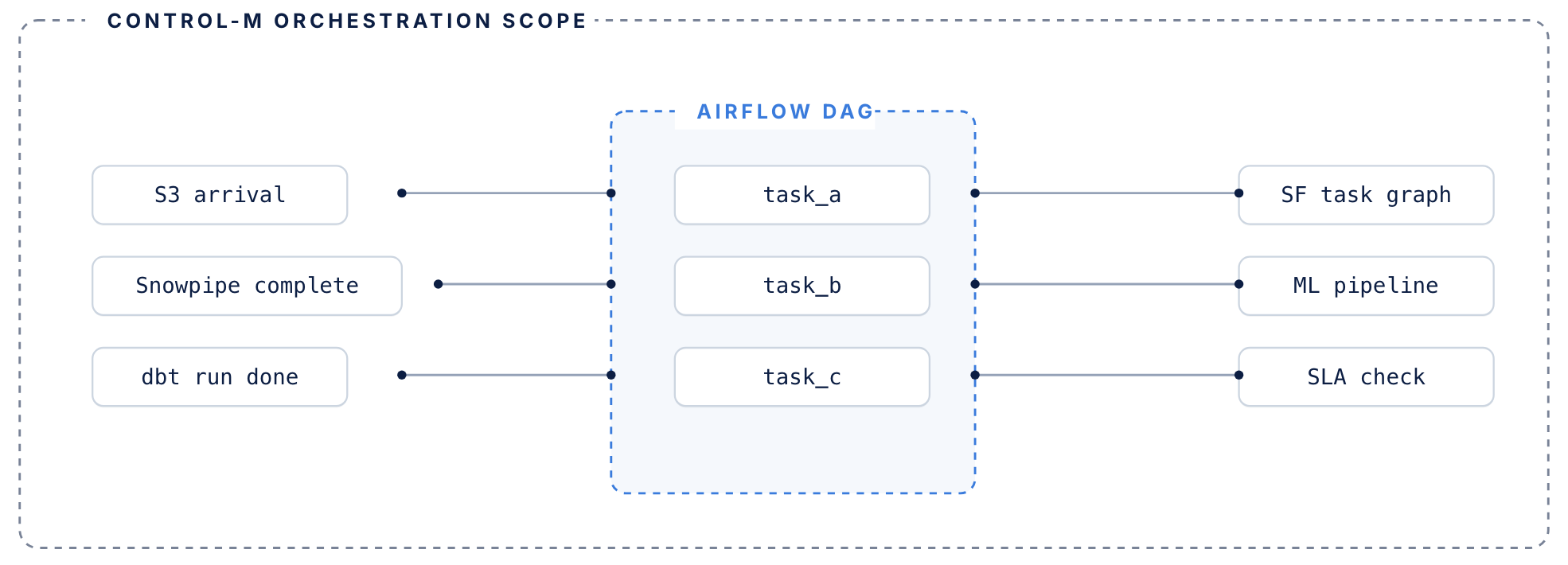
Airflow manages its DAG. Control-M manages everything surrounding it.
airflow handles
DAG-level orchestration inside the data pipeline
- DAG-level task orchestration within data pipelines
- Python operators, sensors, and task dependencies
- Execution graphs for jobs that run inside your pipeline
- Manages retries within a single DAG context
control-m adds
The coordination layer around your DAGs
- Coordination layer around DAGs — triggers Airflow based on upstream conditions: file arrivals, API events, other tool completions
- Tracks each DAG’s SLA contribution across the full end-to-end workflow, not just its own routine
- Manages failure recovery when upstream dependencies fail before Airflow even starts
- Existing DAGs don’t need to be rewritten or migrated
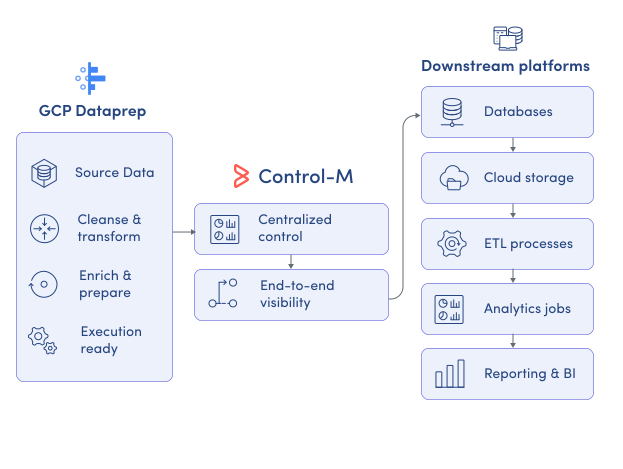
MONITOR ANALYTICS
Monitor GCP Dataprep execution in the wider pipeline
Dataprep execution is only one stage of a production data pipeline. Control-M brings its status, results, and output into the same operational view as surrounding jobs, helping data teams understand dependencies and troubleshoot the complete workflow:
-
Dataprep job execution status
-
Job results and output
-
Upstream and downstream dependencies
-
Cross-platform workflow visibility
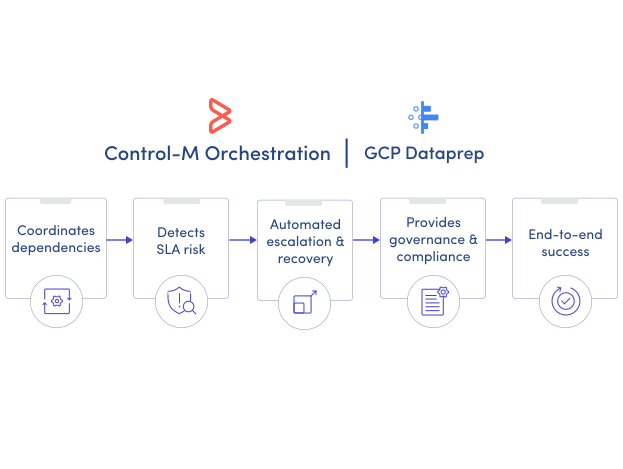
SLA ASSURANCE
Keep Dataprep flows aligned to delivery SLAs
A successful Dataprep run can still be too late for the business outcome it supports. Control-M connects preparation jobs to end-to-end service commitments, giving teams the scheduling, dependency, and SLA controls needed to protect downstream delivery:
-
SLA job attachment
-
Advanced scheduling criteria
-
Complex dependency management
-
End-to-end service visibility
Documentation
Bring order to complex workflows
Learn how Control-M helps teams orchestrate complex processes with greater visibility, coordination, and control.
