Let us know how we can help
Sales & Pricing
Speak to a rep about your business needs

Help & Support
See our product support options
General inquiries and locations
Contact us


 Control-M + Web Services REST
Your Web Services REST workflow starts before a single REST API call is ever dispatched to its configured endpoint — and it can fail when something upstream breaks. A Salesforce Bulk API query result never completes its record export before the job's POST request body is assembled. A ServiceNow table API import set overruns its transformation map timeout before the job's target endpoint receives its staged payload. Control-M orchestrates the full chain: Salesforce ingestion, Boomi transformation, Web Services REST execution, and ServiceNow delivery.
common workflow issues
Does this sound like your week?
These aren’t edge cases. They’re the normal operating conditions for teams running REST API workflows across multiple tools. Here’s how Control‑M handles each one.
API DEPENDENCIES
The API is healthy. The upstream deployment never finished.
Control-M evaluates upstream job completion, deployment status, and dependency conditions before executing the REST call. Failed prerequisites automatically block execution and prevent downstream errors from propagating across environments.
FAILURE RECOVERY
A 503 response at 2:07 AM breaks the workflow.
Control-M detects response codes, evaluates custom success criteria, and applies configurable retry logic with backoff policies. Failed executions can trigger alternate workflows, notifications, or automated remediation actions.
TOKEN MANAGEMENT
The API request failed because credentials expired overnight.
Control-M integrates with enterprise credential vaults and securely retrieves authentication tokens at runtime. Expired secrets can trigger automated refresh workflows before requests are executed.
CROSS-TOOL FLOW
Kubernetes finished. The API trigger never happened.
Control-M orchestrates dependencies across containers, cloud services, databases, and REST endpoints from a single workflow. Event-based triggers eliminate custom scripts and reduce operational gaps between platforms.
SLA VISIBILITY
The endpoint responded. The business process still missed SLA.
Control-M tracks the complete workflow, not just individual API calls. SLA monitoring, breach prediction, and dependency awareness provide visibility into business outcomes before service levels are missed.
INTEGRATION FACTS
Control‑M + Web Services REST
|
API and automation capabilities |
REST API · HTTP/HTTPS requests · GET/POST/PUT/PATCH/DELETE methods · JSON/XML payload support · event-driven execution · webhook integration · API parameterization · dynamic variables |
|
Deployment models & infrastructure flexibility |
SaaS · on-premises · hybrid environments · multi-cloud deployments · containerized platforms · private network connectivity |
|
Security posture |
RBAC · secure credential vault integration · encrypted-in-transit · audit logging · token-based authentication |
|
Incident response & MTTR enablement |
configurable retries · response-code handling · automated recovery workflows · SLA breach alerts · PagerDuty integration · ServiceNow integration · operational notifications |
end-to-end orchestration
One production workflow. Every tool in the stack.
Control-M orchestrates workflows across Web Services REST, Kubernetes, Jenkins, cloud services, databases, file transfers, and enterprise applications in a single job flow — with dependency tracking, SLA visibility, and automated recovery across all of them
- Cross-tool dependency: Jenkins deployment → Kubernetes rollout → REST API call → database update → ServiceNow ticket
- Data-aware triggers: file arrival, API event, webhook notification, application response
|
Web Services REST |
request execution · response validation · authentication handling · API orchestration |
|
Kubernetes |
workload trigger · deployment validation · job status monitoring |
|
Jenkins |
CI/CD pipeline execution · build status tracking · release coordination |
|
AWS Services |
event trigger · workflow orchestration · cloud automation |
|
Databases |
query execution · result validation · dependency management |
|
ServiceNow |
incident creation · ticket updates · escalation workflows |
|
Managed File Transfer |
file delivery validation · event trigger · secure data movement |
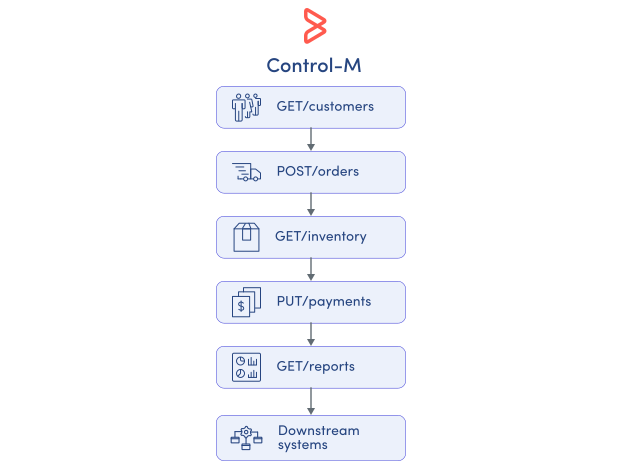
MONITOR APIs
Monitor REST requests and workflow health together.
Native API tooling shows individual requests but rarely provides visibility across the entire workflow. Control-M centralizes execution monitoring, dependencies, and operational status across every connected platform:
-
API execution status
-
Response code tracking
-
Runtime history
-
Dependency visibility
-
Operational audit trail
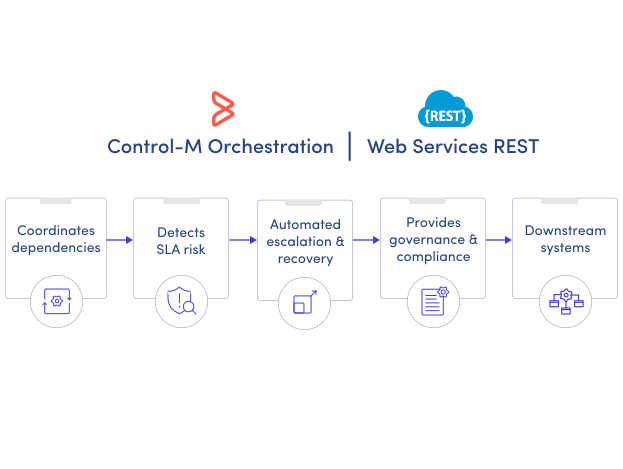
SLA ASSURANCE
Keep API-driven services on schedule.
API success does not guarantee business-process success. Control-M tracks workflow progress, predicts SLA risks, and automates recovery actions across systems before delays impact downstream consumers:
-
SLA breach prediction
-
Automated escalation paths
-
Dependency-aware scheduling
-
Intelligent retry policies
-
Recovery workflow automation
Documentation
Bring order to complex workflows
Learn how Control-M helps teams orchestrate complex processes with greater visibility, coordination, and control.
