Let us know how we can help
Sales & Pricing
Speak to a rep about your business needs

Help & Support
See our product support options
General inquiries and locations
Contact us


 Control-M + VMware
Your VMware workflow starts before a virtual machine ever powers on — and it can fail when something upstream breaks. An Ansible provisioning playbook fails. A nightly database backup runs long. Control-M orchestrates the full chain: backup completion, infrastructure provisioning, VMware execution, and application delivery.
common workflow issues
Does this sound like your week?
These aren’t edge cases. They’re the normal operating conditions for teams running VMware jobs across multiple tools. Here’s how Control-M handles each one.
UPSTREAM FAILURE
Your backup failed at 02:13. The VMware change still has dependencies.
Control-M detects the failed upstream job, prevents dependent VMware operations from starting, and exposes the dependency in the same workflow view. Recovery can resume the chain after the prerequisite succeeds instead of relying on an operator to reconstruct execution order.
POWER OPERATIONS
The application is ready. Its required VM is still powered off.
Control-M executes VMware power operations through the integration and tracks their completion before releasing dependent application jobs. Start, stop, reset, suspend, shutdown, and reboot operations become controlled steps in the production workflow rather than disconnected infrastructure actions.
SNAPSHOT CONTROL
Deployment starts at 22:00. The required VM snapshot never completed.
Control-M makes the VMware snapshot operation an explicit workflow step, monitors its status, and holds downstream execution until completion. Teams can take, revert, or delete snapshots within the orchestrated flow, reducing manual coordination around infrastructure changes.
CONFIGURATION DRIFT
The workload needs more memory. The VM change is still manual.
Control-M can execute supported VMware configuration tasks, including CPU and memory reconfiguration, then coordinate dependent workload execution around the result. Infrastructure changes and application processing follow one controlled sequence instead of separate tickets, scripts, and scheduler windows.
FAILURE DETECTION
vCenter accepted the task. The VMware operation never completed successfully.
Control-M polls VMware job status, applies configured failure tolerance, and exposes job status, results, and output centrally. Failed infrastructure work becomes visible in the same operational context as its upstream and downstream dependencies, accelerating diagnosis and controlled recovery.
INTEGRATION FACTS
Control‑M + VMware by Broadcom
|
API and automation capabilities |
Control-M Automation API · VMware job-as-code definitions · centralized connection profiles · power operations · configuration tasks · snapshot operations · JSON task parameters |
|
Deployment models & infrastructure flexibility |
Control-M SaaS · Control-M self-managed · Linux Agent · Windows Agent · remote vCenter connection · centralized connection profiles · VMware endpoints |
|
Security posture |
secure connection profiles · vCenter username/password authentication · external vault support · centralized credential management · controlled connection profiles |
|
Incident response & MTTR enablement |
job status monitoring · results and output visibility · configurable status polling · failure tolerance · complex dependencies · downstream execution control · SLA jobs |
end-to-end orchestration
One production workflow. Every tool in the stack.
Control-M orchestrates workflows across VMware, Ansible, Terraform, Kubernetes, file transfers, and cloud services in a single job flow — with dependency tracking, SLA visibility, and automated recovery across all of them.
- Cross-tool dependency: Terraform → Ansible → VMware VM → application deployment
- Data-aware triggers: file arrival, API event, provisioning completion, backup completion
|
VMware |
power operations · VM reconfiguration · snapshot operations (take/revert/delete) · job status monitoring · results and output |
|
Ansible |
automation execution · status tracking · dependency coordination |
|
Terraform |
infrastructure workflow orchestration · deployment coordination · dependency tracking |
|
Kubernetes |
workload execution · status tracking · cross-platform dependencies |
|
Cloud services |
cloud job orchestration · dependency management · centralized monitoring |
|
File transfers |
managed transfers · arrival dependencies · delivery confirmation |
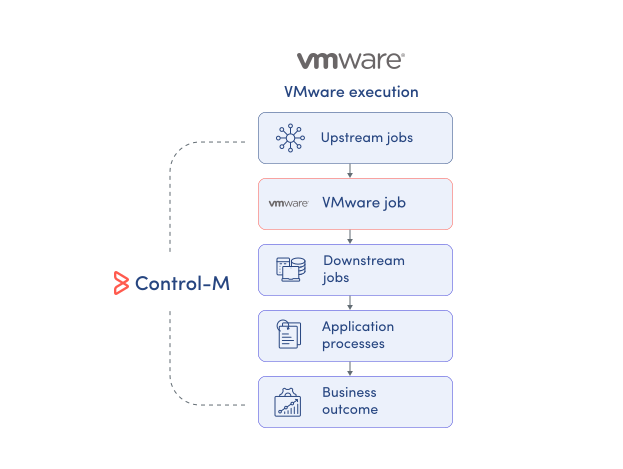
MONITOR INFRASTRUCTURE
Monitor VMware execution across every workflow dependency.
vCenter shows VMware infrastructure activity, but production workflows extend beyond VMware. Control-M provides operational visibility across VMware jobs and the application processes surrounding them, so platform teams can see infrastructure execution in its full workflow context:
-
VMware job execution status
-
Job results and output
-
Upstream and downstream dependencies
-
Runtime and execution history
-
End-to-end workflow visibility
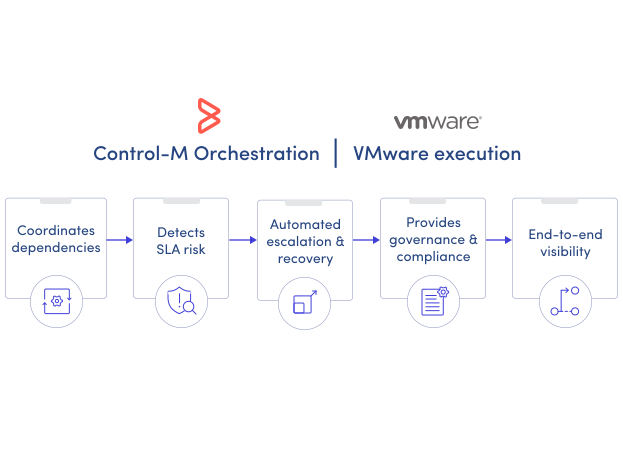
SLA ASSURANCE
Keep VMware-dependent services on schedule.
vCenter tracks infrastructure tasks, not the delivery commitment of the business workflow around them. Control-M connects VMware execution to end-to-end dependencies and SLA management, helping teams identify infrastructure delays before they compromise downstream processing:
-
End-to-end SLA tracking
-
VMware job SLA association
-
Dependency-aware execution control
-
Centralized failure visibility
-
Coordinated workflow recovery
Documentation
Bring order to complex workflows
Learn how Control-M helps teams orchestrate complex processes with greater visibility, coordination, and control.
