Let us know how we can help
Sales & Pricing
Speak to a rep about your business needs

Help & Support
See our product support options
General inquiries and locations
Contact us


 Control-M + UiPath
Your business workflow starts before a UiPath robot executes — and it can fail when something upstream breaks. A required file doesn't arrive. An ERP process isn't ready. Control-M orchestrates the full chain: event monitoring, dependency validation, UiPath execution, outcome validation, and downstream business processes.
common workflow issues
Does this sound like your week?
These aren’t edge cases. They’re the normal operating conditions for teams running UiPath automations across multiple tools. Here’s how Control‑M handles each one.
BOT DEPENDENCIES
The robot is ready. The source file never arrived.
Control-M monitors file arrivals across cloud storage, MFT platforms, and shared locations. It launches UiPath only when required prerequisites are met, preventing failed executions, unnecessary retries, and manual intervention.
SLA RISK
Month-end processing starts late and misses reporting deadlines.
Control-M tracks workflow progress across ERP systems, databases, file transfers, and UiPath robots. SLA monitoring and breach prediction identify delays early, enabling corrective action before critical business deadlines are missed.
FAILURE RECOVERY
A robot failed overnight. Nobody noticed until morning.
Control-M detects execution failures immediately, triggers automated recovery actions, and routes alerts to operational teams. Configurable retries, escalation paths, and dependency-aware handling reduce downtime and accelerate resolution.
CROSS-SYSTEM ORCHESTRATION
SAP finished. Salesforce updated. The robot never triggered.
Control-M coordinates dependencies across enterprise applications and automation platforms. When upstream conditions are satisfied, UiPath processes start automatically without polling scripts, manual monitoring, or disconnected schedulers.
AUDIT COMPLIANCE
Auditors need proof of every automated business action.
Control-M maintains centralized execution records, status history, timestamps, approvals, and operator actions across workflows. Teams gain a complete audit trail for compliance, governance, and operational reporting requirements.
Control‑M + UiPath
Control‑M + UiPath
|
Platform & OS coverage |
Windows Server · Linux Control-M environments · UiPath Orchestrator · hybrid infrastructure · cloud environments |
|
Job types supported |
robotic process automation (RPA) · unattended automation · UiPath process execution · folder-based job dispatching · parameterized robot execution |
|
SLA monitoring & alerting |
SLA window definition · breach prediction · priority-based escalation · email notifications · Slack integration · ServiceNow alerting |
|
Audit trail & access controls |
job-level execution history · role-based access control · approval workflows · centralized audit logs · who-ran-what tracking · compliance reporting |
end-to-end orchestration
One production workflow. Every tool in the stack.
Control-M orchestrates workflows across UiPath, SAP, Salesforce, databases, file transfers, APIs, and cloud services in a single job flow—with dependency tracking, SLA visibility, and automated recovery across all of them.
- Cross-tool dependency: SAP update → file validation → UiPath robot → Salesforce update → customer notification
- Data-aware triggers: file arrival, API event, database update, application status change
|
UiPath |
robot execution · status monitoring · workflow triggering · completion tracking |
|
SAP |
batch coordination · process triggering · dependency management |
|
Salesforce |
update synchronization · workflow handoff · status validation |
|
File Transfers |
arrival detection · validation · automated triggering |
|
Databases |
query execution · dependency checks · result-based automation |
|
REST APIs |
event triggering · status retrieval · orchestration integration |
|
ServiceNow |
incident creation · alert escalation · workflow remediation |
MONITOR AUTOMATIONS
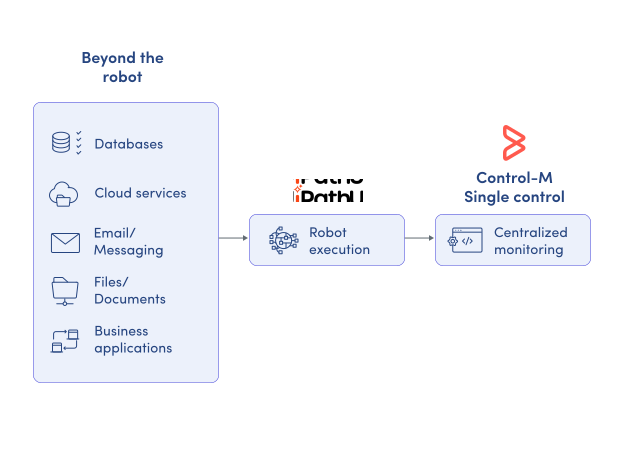
Monitor UiPath operations from a single control point
UiPath provides visibility into robot activity, but business processes often span many systems beyond the robot itself. Control-M provides centralized monitoring across the entire workflow lifecycle, giving operations teams complete visibility into execution status, dependencies, and risk indicators:
-
Robot execution status
-
Runtime history tracking
-
Cross-system dependencies
-
SLA risk indicators
-
Centralized operational view
SLA ASSURANCE
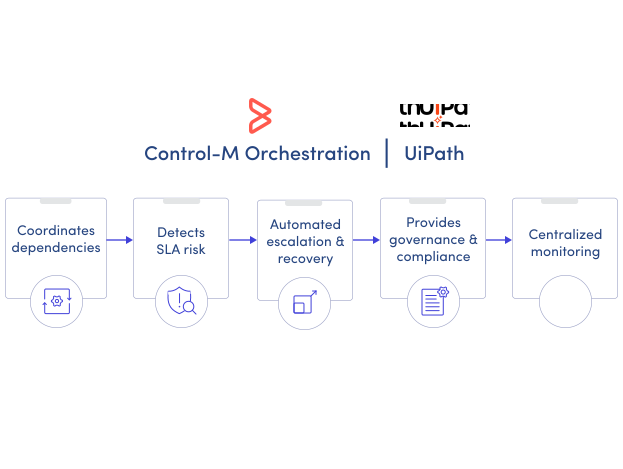
Keep business processes moving when robots fail
Business services depend on successful completion of automated workflows, not individual robot runs. Control-M coordinates recovery actions, escalations, and dependency management across the entire process chain to maintain operational continuity:
-
Automated retry policies
-
Escalation workflows
-
Failure isolation controls
-
Dependency-aware recovery
-
SLA breach prediction
Documentation
Bring order to complex workflows
Learn how Control-M helps teams orchestrate complex processes with greater visibility, coordination, and control.
