Let us know how we can help
Sales & Pricing
Speak to a rep about your business needs

Help & Support
See our product support options
General inquiries and locations
Contact us


 Control-M + Talend Data Management
Your Talend workflow starts before a task ever executes — and it can fail when something upstream breaks. An SFTP delivery arrives late. An Airflow DAG runs long. Control-M orchestrates the full chain: file arrival, upstream processing, Talend execution, and downstream delivery.
common workflow issues
Does this sound like your week?
These aren’t edge cases. They’re the normal operating conditions for teams running Talend Data Management across multiple tools. Here’s how Control‑M handles each one.
LATE DATA ARRIVAL
Your 2:00 AM Talend task started. The SFTP file didn’t arrive.
Control-M watches for the required file and holds Talend execution until the arrival condition is satisfied. The workflow starts from the data event instead of a guessed schedule, preventing incomplete inputs from cascading downstream.
UPSTREAM DELAY
Your Airflow DAG ran long. Talend is scheduled for 4:00 AM.
Control-M models the Airflow DAG and Talend task as dependencies in one workflow. Talend starts after the required upstream completion rather than the clock, eliminating brittle schedule offsets and reducing premature executions.
FAILED EXECUTION
A Talend task failed. Three downstream jobs are ready to run.
Control-M detects the Talend execution status, prevents dependent jobs from proceeding, and exposes task output for troubleshooting. Recovery can resume through controlled workflow logic instead of letting a failed transformation contaminate downstream processing.
TRANSIENT API FAILURE
Talend is healthy. The API request returned a retryable HTTP error.
Control-M supports configurable HTTP Codes, Rerun Interval, and Rerun Attempts in the Talend Data Management connection profile (available in plug-in v1.0.07 and later; minimum Application Integrator 9.0.21.301/9.0.21.300). Transient integration failures can be retried automatically before they become manual incidents or break the wider workflow.
SLA RISK
Talend is still running. The 7:00 AM analytics handoff is approaching.
Control-M connects the Talend workload to the end-to-end service SLA, so operators can see its impact in the wider workflow and respond before a delayed task puts the business delivery window at risk.
INTEGRATION FACTS
Control‑M + Talend Data Management
|
workload.types |
Talend tasks · Talend plans · task execution by name · task execution by task ID · task execution by environment ID |
|
trigger.type |
file arrival · upstream job completion · API-driven execution · time schedule · Control-M event · cross-platform dependency |
|
cross_tool.deps |
Apache Airflow DAG · SFTP/file transfer · Snowflake workload · Databricks job · database job · REST API call · downstream analytics |
|
cloud.platforms |
Talend Cloud regional endpoints (Talend Cloud only — on-premises Talend is not supported) · Control-M Agent on AWS, Azure, or GCP · Control-M SaaS |
|
error_handling |
HTTP-code rerun · configurable rerun attempts · rerun interval · downstream dependency hold · failed-plan log retrieval · SLA monitoring |
|
throughput |
task status polling · plan status polling · multi-Agent scale-out |
|
observability |
task status · task output · Talend task logs · failed plan log retrieval · Control-M Monitoring · end-to-end SLA visibility |
end-to-end orchestration
One production workflow. Every tool in the stack.
Control-M orchestrates workflows across Talend Data Management, Apache Airflow, Snowflake, Databricks, file transfers, and cloud services in a single job flow — with dependency tracking, SLA visibility, and automated recovery across all of them.
- Cross-tool dependency: file arrival → Talend task → Snowflake load → analytics handoff
- Data-aware triggers: file arrival, API event, Talend task completion, database load completion
|
Talend Data Management |
execute tasks · execute plans · pass parameters · retrieve logs · track status |
|
Apache Airflow |
trigger DAGs · track execution · coordinate upstream/downstream dependencies |
|
Snowflake |
orchestrate data workloads · coordinate dependencies · monitor execution |
|
Databricks |
orchestrate jobs · sequence processing · connect downstream workflows |
|
Managed File Transfer |
watch file arrival · transfer files · trigger dependent processing |
|
Cloud services |
coordinate AWS · Azure · Google Cloud workloads across workflows |
airflow coexistance
Control-M doesn’t replace your Airflow DAGs. It runs the layer above them.
The objection is common: “We’re already on Airflow.” The issue isn’t what Airflow does – it’s what happens before and after Airflow runs. That’s where pipelines actually fail.
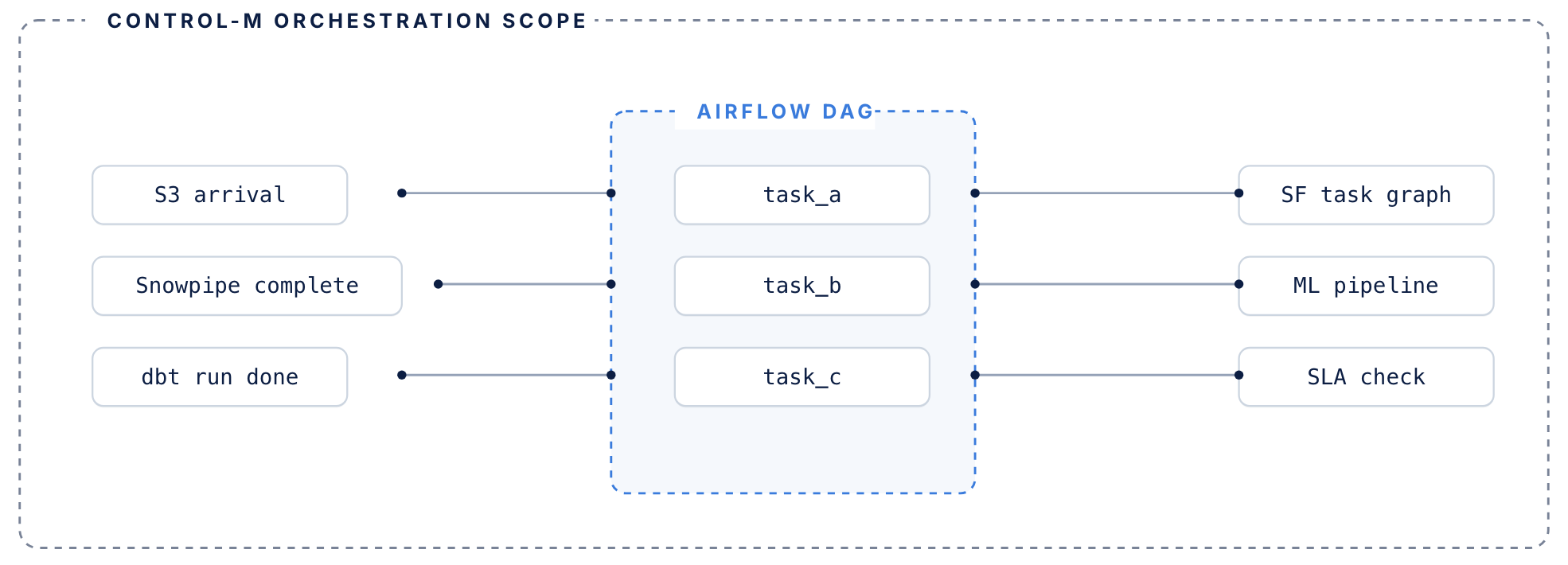
Airflow manages its DAG. Control-M manages everything surrounding it.
airflow handles
DAG-level orchestration inside the data pipeline
- DAG-level task orchestration within data pipelines
- Python operators, sensors, and task dependencies
- Execution graph for jobs that run inside your pipeline
- Manages retries within a single DAG context
control-m adds
The coordination layer around your DAGs
- Coordination layer around DAGs — triggers Airflow based on upstream conditions: file arrivals, API events, other tool completions
- Tracks each DAG’s SLA contribution across the full end-to-end workflow, not just its own routine
- Manages failure recovery when upstream dependencies fail before Airflow even starts
- Existing DAGs don’t need to be rewritten or migrated
MONITOR PIPELINES
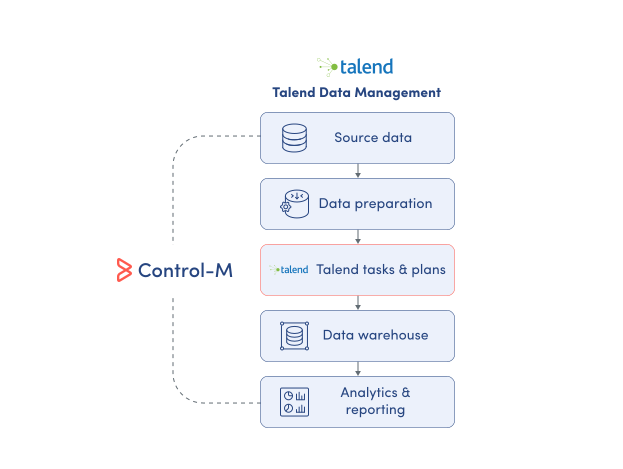
Monitor Talend execution across the full data pipeline.
Talend Management Console shows Talend execution, but production data flows rarely stop at Talend. Control-M brings Talend status and output into the same operational view as upstream and downstream workloads, giving data teams one place to follow execution:
-
Task and plan status
-
Talend task log output
-
Upstream and downstream dependencies
-
Cross-platform workflow monitoring
-
Failed plan log visibility
SLA ASSURANCE
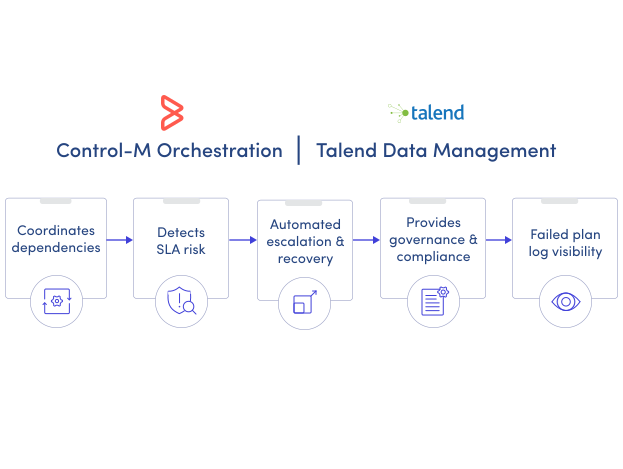
Keep Talend pipelines aligned to delivery SLAs.
A successful Talend task can still be part of a late business service. Control-M connects Talend execution to the complete workflow and its delivery requirement, helping teams manage dependencies and identify service-level risk across the chain:
-
End-to-end SLA tracking
-
Cross-tool dependency visibility
-
Critical workflow status
-
Centralized failure monitoring
-
Controlled downstream execution
Documentation
Bring order to complex workflows
Learn how Control-M helps teams orchestrate complex processes with greater visibility, coordination, and control.
