Let us know how we can help
Sales & Pricing
Speak to a rep about your business needs

Help & Support
See our product support options
General inquiries and locations
Contact us


 Control-M + Sqoop
Your Sqoop workflow starts before an import or export command ever executes — and it can fail when something upstream breaks. A source table in MySQL isn’t ready for extraction. A Hive transformation finishes late and misses the export window. Control-M orchestrates the full chain: relational data availability, Hadoop preparation, Sqoop execution, and downstream processing.
common workflow issues
Does this sound like your week?
DATABASE READINESS
Your 2:00 a.m. import starts. The MySQL source table isn’t ready.
Control-M holds the Sqoop job until its upstream database process completes successfully, then releases the import automatically. Dependency-based execution prevents premature extraction and keeps incomplete relational data from propagating into HDFS.
IMPORT FAILURE
A Sqoop import fails halfway through. Downstream Hive processing is queued.
Control-M detects the failed job state, applies defined recovery actions, and prevents dependent Hive processing from starting prematurely. Operations teams can recover the failed step without allowing bad or incomplete data to cascade downstream.
HDFS PREPARATION
The target HDFS path isn’t ready when your Sqoop command starts.
Control-M can execute HDFS pre-commands before the Sqoop job and control whether command failure stops execution. Preparation, transfer, and cleanup become governed steps in the same workflow instead of loosely coordinated shell operations.
EXPORT TIMING
Hive finishes late. Your database export still follows yesterday’s clock.
Control-M makes the Sqoop export dependent on actual upstream completion rather than an assumed start time. The export begins when its data is ready, protecting downstream database consumers from stale or incomplete results.
PIPELINE SLA
Sqoop finished successfully. The end-to-end data delivery is still late.
Control-M tracks the Sqoop job as part of the complete business workflow, including upstream and downstream dependencies. SLA monitoring exposes delay risk beyond one job, helping teams intervene before the overall data delivery misses its deadline.
Control‑M + Sqoop
Control‑M + Sqoop
|
workload.types |
Sqoop imports · Sqoop exports · incremental imports · free-form query imports · Hive imports · HBase imports · HDFS-to-RDBMS exports |
|
trigger.type |
time schedule · upstream job completion · HDFS file arrival · Control-M event · API-triggered order · upstream job exit state |
|
cross_tool.deps |
Hive job · Spark job · MapReduce job · HDFS File Watcher · database process · REST API call · downstream analytics job |
|
cloud.platforms |
Hadoop edge nodes · on-premises Hadoop · cloud-hosted Hadoop · hybrid environments · Control-M SaaS · self-hosted Control-M |
|
error_handling |
pre-command failure control · post-command failure control · configurable rerun · downstream cascade prevention · job-state detection · SLA alerting |
|
throughput |
parallel bulk transfer · mapper-controlled parallelism · incremental imports · large relational datasets · HDFS batch processing · bulk database exports |
|
observability |
job status monitoring · job output · execution history · dependency visibility · SLA tracking · centralized workflow monitoring |
end-to-end orchestration
One production workflow. Every tool in the stack.
Control-M orchestrates workflows across Sqoop, Hadoop, HDFS, Hive, Spark, databases, and analytics services in a single job flow — with dependency tracking, SLA visibility, and automated recovery across all of them.
- Cross-tool dependency: database load → Sqoop import → Hive transformation → analytics handoff
- Data-aware triggers: HDFS file arrival, upstream completion, Control-M event, job exit state
|
Sqoop |
import/export execution · command options · files/archives · pre/post HDFS commands |
|
HDFS |
file watching · preparation commands · file dependencies · downstream handoff |
|
Hive |
query execution · transformation dependency · completion tracking · downstream triggering |
|
Spark |
processing execution · dependency coordination · status monitoring · workflow handoff |
|
Relational databases |
source readiness · JDBC-connected Sqoop transfer · upstream/downstream dependency |
|
Control-M Automation API |
job definitions · deployment · ordering · workflow automation |
|
Analytics services |
downstream dependency · scheduled delivery · SLA coordination · completion handoff |
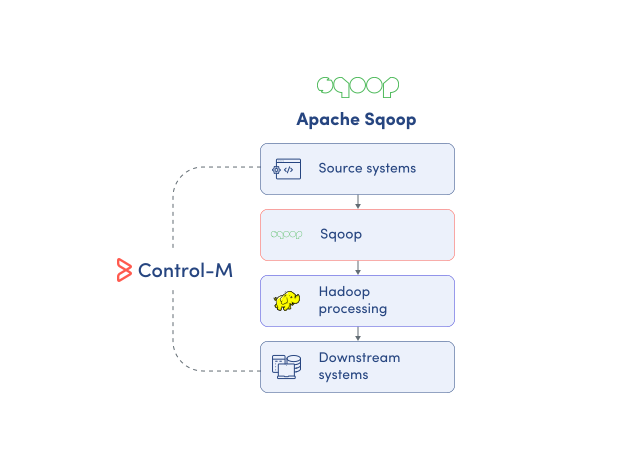
MONITOR PIPELINES
Monitor Sqoop jobs inside the complete data pipeline
Sqoop executes data movement, but its command-level view does not show whether the complete cross-platform workflow will finish successfully. Control-M centralizes execution and dependency visibility across Sqoop and surrounding processing:
-
Sqoop execution status
-
Job output and runtime history
-
Upstream and downstream dependencies
-
Cross-platform workflow status
-
End-to-end SLA risk
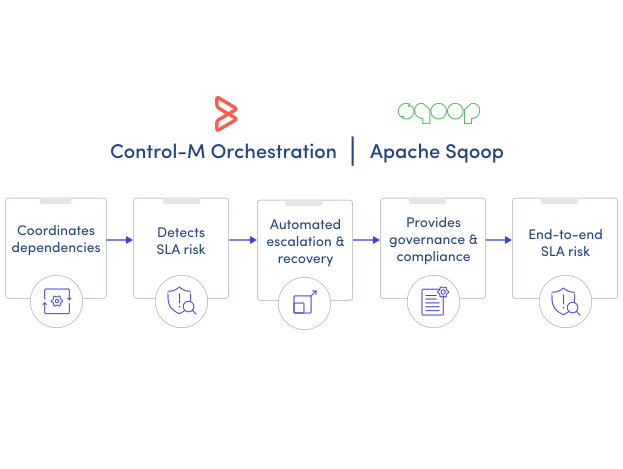
SLA ASSURANCE
Keep Sqoop-dependent data deliveries on schedule
A successful Sqoop command does not guarantee that the business pipeline meets its delivery window. Control-M tracks dependencies and timing across the complete workflow so teams can identify delays and protect critical data SLAs:
-
End-to-end SLA tracking
-
Upstream delay visibility
-
Dependency-aware execution
-
Failure-driven cascade prevention
-
Centralized operational alerts
