Let us know how we can help
Sales & Pricing
Speak to a rep about your business needs

Help & Support
See our product support options
General inquiries and locations
Contact us


 Control-M + SAP S/4HANA
Your SAP S/4HANA workflow starts before an ABAP background job ever executes — and it can fail when something upstream breaks. An SAP Integration Suite iFlow fails to deliver required data. An SAP BW process chain finishes late and misses the dependent processing window. Control-M orchestrates the full chain: inbound data arrival, integration-layer transformation, SAP S/4HANA execution, and downstream delivery.
common workflow issues
Does this sound like your week?
UPSTREAM FAILURE
The 2 a.m. interface failed. Your morning SAP run never started.
Control-M tracks the upstream dependency and prevents the dependent SAP S/4HANA job from running prematurely. It can alert the responsible team and apply defined recovery actions, keeping incomplete inputs from cascading into a business-critical process.
CROSS-SYSTEM FLOW
SAP finished successfully. The downstream business process is still waiting.
Control-M evaluates completion across the wider workflow, not only the SAP job. It coordinates dependencies between SAP S/4HANA and connected applications, file transfers, cloud services, and data platforms so the next qualified step starts automatically.
SLA RISK
Financial close is running late. Reporting starts in 30 minutes.
Control-M monitors the end-to-end service against its deadline and identifies SLA risk across contributing jobs and dependencies. Teams gain earlier warning and centralized visibility, giving process owners time to act before a late SAP step affects reporting.
FAILURE RECOVERY
Step six failed overnight. Restarting everything would repeat completed work.
Control-M can rerun an SAP R/3 job from its point of failure or from a specified step, depending on configuration. Recovery targets the affected processing rather than automatically repeating successfully completed work, reducing unnecessary execution and recovery time.
SPAWNED JOBS
The parent completed. One spawned SAP job failed unnoticed.
Control-M can detect and monitor SAP jobs spawned by a parent job and make parent completion dependent on child-job completion and status. Process owners get a more accurate view of whether the complete SAP workload actually succeeded.
INTEGRATION FACTS
Control‑M + SAP S/4HANA
|
Platform & OS coverage |
SAP S/4HANA on-premises and cloud · SAP ECC · SAP BW · SAP BTP · hybrid SAP/non-SAP environments |
|
Job types supported |
SAP R/3 jobs for S/4HANA · ABAP programs · external programs · external commands · batch input sessions · SAP events · data archiving |
|
SLA monitoring & alerting |
SLA job association · end-to-end service monitoring · breach prediction · centralized alerts · dependency monitoring · business deadline visibility |
|
Audit trail & access controls |
job execution history · SAP job logs · spool output · role-based administration · connection-profile authorization · centralized workflow traceability |
end-to-end orchestration
One production workflow. Every tool in the stack.
Control-M orchestrates workflows across SAP S/4HANA, SAP Integration Suite, SAP BW, SAP BTP, file transfers, and cloud services in a single job flow — with dependency tracking, SLA visibility, and automated recovery across all of them.
- Cross-tool dependency: inbound file → SAP Integration Suite flow → SAP S/4HANA job → SAP BW reporting
- Data-aware triggers: file arrival, SAP event, upstream job completion, API event
|
SAP S/4HANA |
ABAP job execution · SAP event handling · status monitoring · rerun from failure · dependency management |
|
SAP Integration Suite |
integration-flow coordination · status-aware dependencies · cross-system sequencing |
|
SAP BW |
Process Chain execution · status monitoring · restart handling · downstream coordination |
|
SAP BTP |
scheduler-job orchestration · SAP/cloud workflow coordination · dependency management |
|
Managed File Transfer |
secure file delivery · file-arrival dependencies · transfer monitoring |
|
Cloud services |
event-driven execution · cross-platform dependencies · workflow coordination |
|
Enterprise applications |
upstream/downstream sequencing · completion tracking · end-to-end SLA control |
MONITOR PROCESSES
See SAP S/4HANA execution in business-process context.
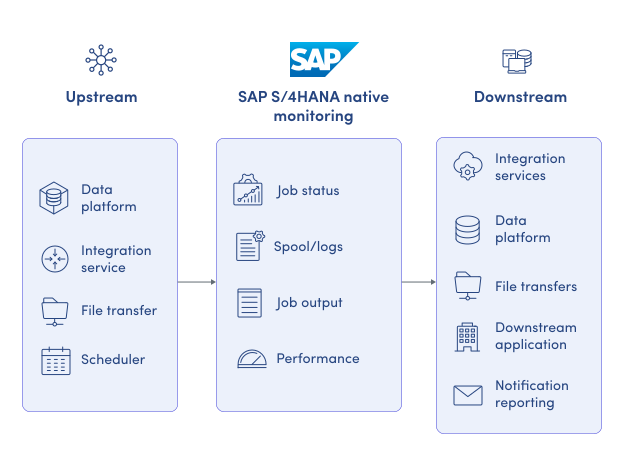
SAP provides native job monitoring, but a business process can continue across integration services, data platforms, file transfers, and downstream applications after an SAP job ends. Control-M gives domain owners centralized visibility across that wider execution chain:
-
SAP job execution status
-
Upstream and downstream dependencies
-
Job logs and output
-
End-to-end process status
-
Failure and exception visibility
Show a Control-M monitoring view with an SAP S/4HANA job at the center of an end-to-end workflow, including an upstream file/integration step and downstream reporting step, with job status and dependency relationships visible.
SLA ASSURANCE
Keep critical SAP business processes on schedule.
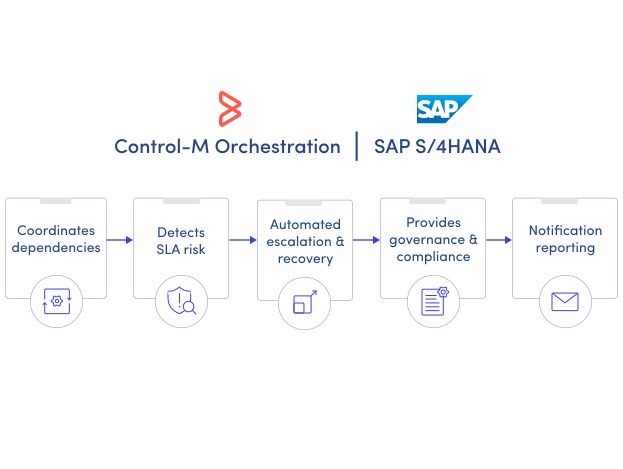
SAP S/4HANA can schedule and monitor its application jobs, but business deadlines depend on work outside the SAP boundary too. Control-M tracks the complete workflow and its dependencies so process owners can manage execution against the outcome that matters:
-
Predictive SLA risk visibility
-
Cross-system dependency tracking
-
Automated recovery actions
-
Business deadline monitoring
-
Centralized operational alerts
