Let us know how we can help
Sales & Pricing
Speak to a rep about your business needs

Help & Support
See our product support options
General inquiries and locations
Contact us


 Control-M + Oozie
Your Oozie workflow starts before a single action ever executes — and it can fail when something upstream breaks. An HDFS dataset arrives late. A Hive transformation misses its processing window. Control-M orchestrates the full chain: HDFS data arrival, Hive transformation, Oozie workflow execution, and downstream delivery.
common workflow issues
Does this sound like your week?
LATE HDFS DATA
Your 2:00 AM workflow is ready. The HDFS dataset isn’t.
Control-M can watch HDFS for the required file and minimum size before releasing dependent processing. Maximum wait criteria hold dependent Oozie processing until the file arrives complete — so a missing or late arrival surfaces as a controlled, visible wait or timeout instead of letting downstream processing start with unavailable data.
WORKFLOW FAILURE
An Oozie action failed. Everything downstream is still depending on it.
Control-M tracks the Oozie job within the wider workflow and can prevent dependent jobs from continuing after failure. Rerun-from-point-of-failure restarts the workflow at the failed action, so the already-completed portion of the workflow does not run again.
PROPERTY DRIFT
Yesterday’s properties worked. Today’s input path needs a different value.
Control-M submits the Oozie workflow using its job properties file and can add or override individual property values at execution time. Teams can parameterize changing inputs without maintaining separate workflow definitions for every production variation.
CROSS-TOOL DEPENDENCIES
Oozie finished successfully. The enterprise workflow still has three steps left.
Control-M connects Hadoop processing with jobs outside the Oozie workflow, applying scheduling criteria and dependencies across the complete business process. Downstream database, file-transfer, application, or analytics work can wait for the correct upstream completion state.
WORKFLOW VISIBILITY
The Oozie workflow is running. Operations needs action-level visibility now.
The Oozie Extractor periodically retrieves matching workflows from the Oozie server and pushes their actions into Control-M as submitted jobs. Operations gains centralized visibility into those actions alongside the surrounding enterprise workflow instead of monitoring Oozie in isolation.
Control‑M + Oozie
Control‑M + Oozie
|
workload.types |
Oozie workflows · workflow actions · Hadoop jobs · Hive jobs · Spark jobs · MapReduce jobs · HDFS processing |
|
trigger.type |
time schedule · upstream job completion · HDFS file arrival · minimum file size · Control-M dependency · workflow submission |
|
cross_tool.deps |
HDFS File Watcher · Hive job · Spark job · MapReduce job · Sqoop job · enterprise Control-M jobs · downstream delivery |
|
cloud.platforms |
Hadoop clusters · Linux Control-M Agent · Oozie server · HDFS. |
|
error_handling |
rerun from point of failure · pre-command failure handling · post-command failure handling · dependency gating · SLA monitoring · downstream cascade prevention |
|
throughput |
distributed Hadoop processing · scheduled batch pipelines · large-data workflows · parallel Hadoop actions · centrally orchestrated workloads |
|
observability |
Oozie Extractor · workflow-action visibility · Control-M Monitoring domain · job output · activity log · execution statistics · SLA tracking |
end-to-end orchestration
One production workflow. Every tool in the stack.
Control-M orchestrates workflows across Oozie, HDFS, Hive, Spark, MapReduce, Sqoop, and enterprise applications in a single job flow — with dependency tracking, SLA visibility, and automated recovery across all of them.
- Cross-tool dependency: HDFS arrival → Hive transformation → Oozie workflow → downstream analytics
- Data-aware triggers: HDFS file arrival, minimum file size, upstream completion, time schedule
|
Oozie |
workflow submission · property overrides · failure-point rerun · workflow extraction |
|
HDFS |
file watching · minimum-size criteria · wait timeout · HDFS commands |
|
Hive |
script execution · parameters · Hadoop dependencies · execution monitoring |
|
Spark |
Python execution · Java/Scala execution · dependencies · centralized scheduling |
|
MapReduce |
Java MapReduce execution · streaming jobs · arguments · workflow dependencies |
|
Sqoop |
Sqoop command execution · data movement orchestration · upstream/downstream dependencies |
|
Enterprise workflows |
cross-platform dependencies · scheduling · SLA management · centralized monitoring |
airflow coexistance
Control‑M doesn’t replace your Airflow DAGs. It runs the layer above them.
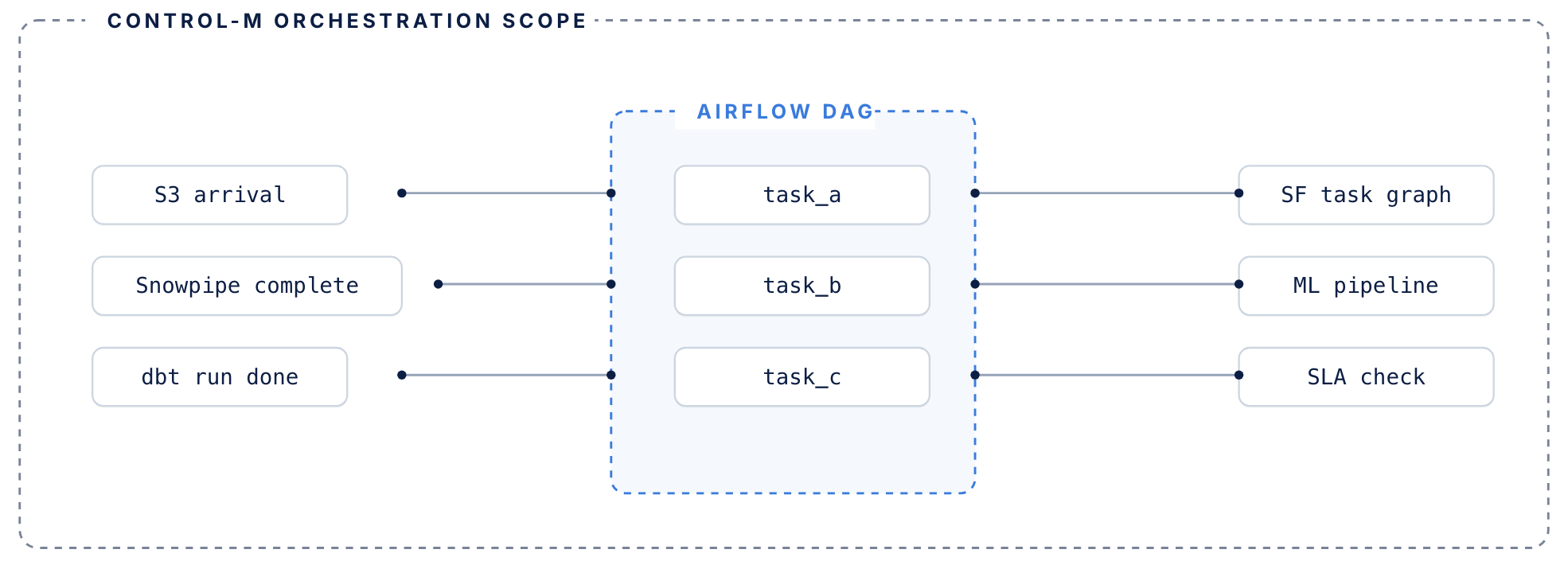
Airflow manages its DAG. Control-M manages everything surrounding it.
airflow handles
DAG-level orchestration inside the data pipeline
- DAG-level task orchestration within data pipelines
- Python operators, sensors, and task dependencies
- Execution graph for jobs that run inside your pipeline
- Manages retries within a single DAG context
control-m adds
The coordination layer around your DAGs
- Coordination layer around DAGs — triggers Airflow based on upstream conditions: file arrivals, API events, other tool completions
- Tracks each DAG’s SLA contribution across the full end-to-end workflow, not just its own routine
- Manages failure recovery when upstream dependencies fail before Airflow even starts
- Existing DAGs don’t need to be rewritten or migrated
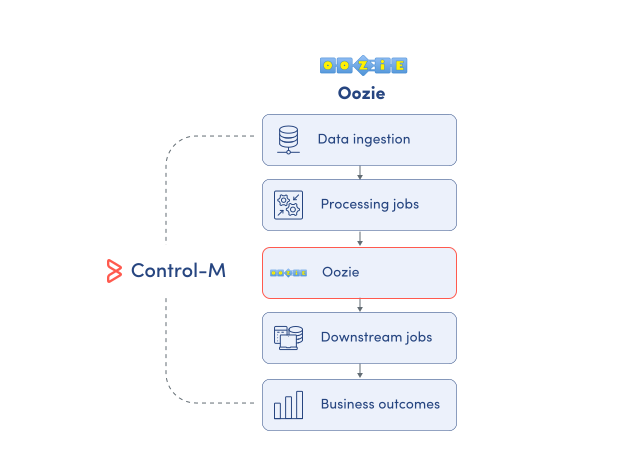
MONITOR WORKFLOWS
See Oozie workflows in the wider production pipeline.
Oozie shows what happens inside its workflows, but data engineering teams also need visibility into the jobs surrounding them. Control-M brings Oozie execution into centralized monitoring with upstream and downstream workflow context:
-
Oozie workflow action visibility
-
Upstream and downstream dependencies
-
Job output and activity logs
-
Runtime and execution statistics
-
End-to-end workflow status
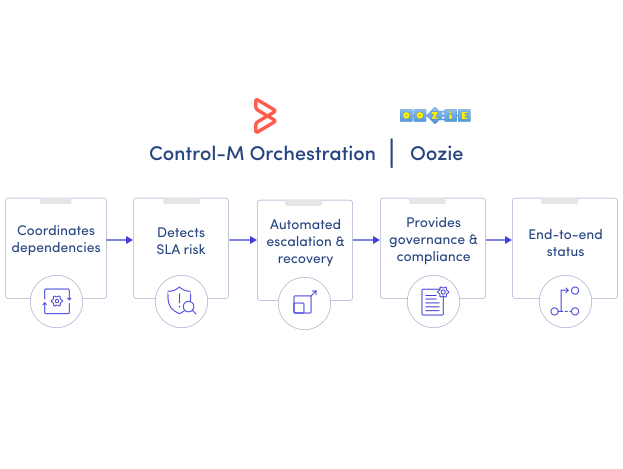
SLA ASSURANCE
Manage Oozie pipelines against end-to-end SLAs
A successful Oozie workflow does not guarantee the complete data pipeline finishes on time. Control-M connects Hadoop processing to enterprise scheduling and SLA management, helping teams manage delivery commitments across the full workflow:
-
End-to-end SLA tracking
-
Cross-platform dependency control
-
Advanced scheduling criteria
-
Failure-aware downstream gating
-
Centralized production monitoring