Let us know how we can help
Sales & Pricing
Speak to a rep about your business needs

Help & Support
See our product support options
General inquiries and locations
Contact us


 Control-M + OCI Data Integration
Your OCI Data Integration workflow starts before a task run ever executes its predefined integration function — and it can fail when something upstream breaks. An OCI Object Storage bucket never receives the staged extract from an Oracle Fusion Cloud application. An OCI Data Flow job overruns its driver timeout before writing its Spark-processed output to the target schema. Control-M orchestrates the full chain: Oracle Fusion Cloud extraction, OCI Data Flow transformation, OCI Data Integration execution, and Oracle Autonomous Data Warehouse delivery.
common workflow issues
Does this sound like your week?
These aren’t edge cases. They’re the normal operating conditions for teams running OCI Data Integration pipelines across multiple tools. Here’s how Control‑M handles each one.
DATA ARRIVAL
The source file missed the window. The integration task still launched.
Control-M validates file arrival, size, naming conventions, and completeness before triggering OCI Data Integration. Dependency-aware execution prevents downstream jobs from running on incomplete datasets and reduces avoidable failures.
CROSS-SYSTEM DEPENDENCIES
Oracle Database finished late. Your transformation schedule didn’t adjust.
Control-M uses event-driven orchestration and exit-state monitoring to launch OCI Data Integration tasks only when upstream systems complete successfully, eliminating static timing assumptions and reducing unnecessary reruns.
FAILURE RECOVERY
One mapping failed at 2:17 AM. Everything downstream stopped.
Control-M detects failed execution states, applies configurable recovery actions, retries where appropriate, and prevents downstream cascades. Operators receive targeted alerts with workflow context instead of discovering failures hours later.
MULTI-CLOUD DATA
AWS finished. OCI didn’t. Nobody noticed until reporting failed.
Control-M coordinates dependencies across OCI, AWS, Azure, databases, APIs, and file transfers from a single workflow. Cross-platform visibility exposes bottlenecks early and keeps delivery schedules predictable.
SLA RISK
The pipeline is running. The delivery deadline is still at risk.
Control-M continuously evaluates workflow progress against defined SLAs, predicts breaches before they occur, and escalates issues automatically so teams can intervene before business reporting deadlines are missed.
INTEGRATION FACTS
Control‑M + OCI Data Integration
|
workload.types |
data integration tasks · pipeline tasks · data loader tasks · SQL tasks · batch integrations · data loading jobs · scheduled data movement |
|
trigger.type |
file arrival (Object Storage · SFTP) · API/webhook · database event · time schedule · upstream job completion · workflow status event |
|
cross_tool.deps |
Oracle Database completion · OCI Object Storage event · Apache Airflow DAG trigger · Spark job execution · REST API call · ERP data extract · file delivery confirmation |
|
cloud.platforms |
Oracle Cloud Infrastructure (OCI) · AWS · Microsoft Azure · Google Cloud Platform · Control-M SaaS · Control-M on-premises |
|
error_handling |
configurable retry count · interval controls · downstream cascade prevention · automated hold on failure · SLA breach alerting · PagerDuty · Slack |
|
throughput |
high-volume ETL · large-scale batch processing · parallel data transformations · event-driven orchestration · enterprise data movement |
|
observability |
job-level audit log · SLA monitoring and prediction · dependency lineage graph · centralized workflow visibility · Datadog integration · Splunk integration |
end-to-end orchestration
One production workflow. Every tool in the stack.
Control-M orchestrates workflows across OCI Data Integration, Oracle Database, Apache Airflow, Spark, OCI Object Storage, file transfers, and cloud services in a single job flow — with dependency tracking, SLA visibility, and automated recovery across all of them.
- Cross-tool dependency: Oracle Database extract → OCI Data Integration flow → Spark processing → BI dashboard refresh
- Data-aware triggers: file arrival, API event, database completion, transformation completion
|
OCI Data Integration |
workflow execution · status monitoring · dependency control · failure handling |
|
|
Oracle Database |
extract completion tracking · SQL execution · event-based triggering |
|
|
OCI Object Storage |
file arrival monitoring · validation · ingestion triggers |
|
|
Apache Airflow |
DAG triggering · status tracking · workflow coordination |
|
|
OCI Data Flow (Apache Spark) |
job execution · dependency management · completion tracking |
|
|
REST APIs |
process initiation · status retrieval · event coordination |
|
|
BI Platforms |
report refresh trigger · delivery coordination · SLA tracking |
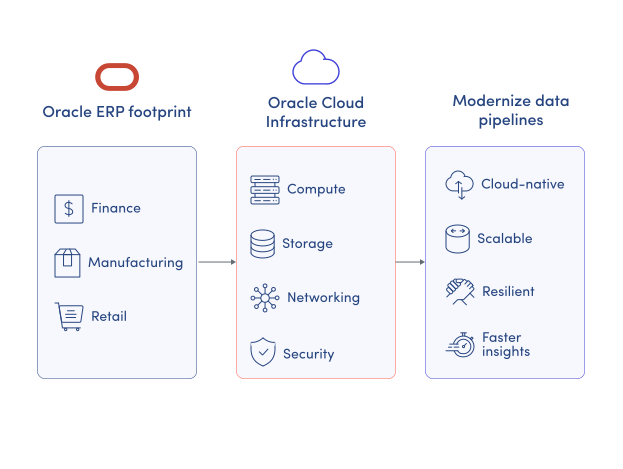
MONITOR PIPELINES
Monitor OCI Data Integration workflows in one place
OCI Data Integration provides execution visibility within its own environment, but modern data pipelines span databases, storage services, APIs, and analytics platforms.
Control-M provides centralized monitoring across the entire workflow so teams can quickly identify risk and bottlenecks:
-
Workflow execution status
-
Runtime trend analysis
-
Upstream dependencies
-
Downstream dependencies
-
SLA risk indicators
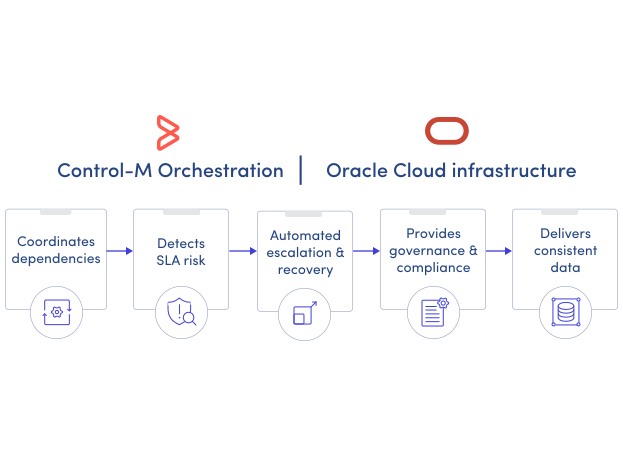
sla assurance
Protect downstream delivery commitments automatically
OCI Data Integration can execute transformations, but it does not manage enterprise-wide delivery commitments across connected platforms.
Control-M continuously evaluates workflow progress, predicts SLA breaches, and automates escalation and recovery actions before deadlines are missed:
-
SLA breach prediction
-
Automated escalation workflows
-
Deadline-aware scheduling
-
Dependency-based recovery
-
Service delivery tracking
Documentation
Bring order to complex workflows
Learn how Control-M helps teams orchestrate complex processes with greater visibility, coordination, and control.
