Let us know how we can help
Sales & Pricing
Speak to a rep about your business needs

Help & Support
See our product support options
General inquiries and locations
Contact us


 Control-M + MySQL
Your MySQL workflow starts before a SQL script ever executes — and it can fail when something upstream breaks. An S3 extract arrives incomplete. A dbt Cloud transformation finishes after its processing window. Control-M orchestrates the full chain: source data arrival, upstream transformation, MySQL execution, and downstream delivery.
common workflow issues
Does this sound like your week?
DATA ARRIVAL
Your S3 extract is late. The MySQL load cannot start safely.
Control-M waits for the required data arrival before releasing the MySQL load, rather than relying on a fixed schedule. Dependency handling prevents premature SQL execution and downstream processing against missing or incomplete data.
SQL FAILURE
Your 2:00 a.m. SQL script failed. Downstream jobs are still queued.
Control-M detects the database job’s execution status, applies defined recovery actions, and prevents dependent jobs from proceeding after failure. Teams can retry or remediate the failed step without blindly advancing the rest of the workflow.
CROSS-TOOL DEPENDENCY
Your dbt transformation finished. The MySQL processing step is still waiting.
Control-M coordinates completion dependencies across tools, releasing the MySQL step when its upstream conditions are satisfied. The workflow advances from transformation to database processing without separate cron schedules, polling scripts, or manual intervention.
CONNECTION FAILURE
The MySQL connection dropped mid-run. Your morning pipeline is now at risk.
Control-M centralizes execution status and supports configurable connection retry behavior and workflow recovery. Failed database processing stays visible in the end-to-end flow, helping operators restore processing without allowing the failure to cascade downstream.
SLA RISK
The MySQL load is running long. Your analytics handoff starts at 6:00.
Control-M tracks the MySQL step within the end-to-end service and identifies SLA risk before the final deadline is missed. Operations teams can see the affected dependencies and intervene before delayed database processing impacts downstream delivery.
Control‑M + MySQL
Control‑M + MySQL
|
workload.types |
SQL scripts · embedded SQL queries · stored procedures |
||
|
trigger.type |
file arrival · upstream job completion · API/webhook · time schedule · upstream job exit code |
||
|
cross_tool.deps |
Apache Airflow DAG · dbt transformation · Fivetran sync · Spark/Databricks job · REST API call · file transfer |
||
|
cloud.platforms |
AWS · Microsoft Azure · Google Cloud Platform · on-premises · hybrid environments |
||
|
error_handling |
connection profile retry/rerun settings · configurable rerun interval and attempt count · downstream cascade prevention · job hold · SLA alerting |
||
|
throughput |
high-volume batch SQL processing · bulk data loads · scheduled ETL processing |
||
|
observability |
execution log · SQL output · job status · runtime history · dependency visibility · SLA tracking · workflow monitoring |
end-to-end orchestration
One production workflow. Every tool in the stack.
Control-M orchestrates workflows across MySQL, Airflow, dbt, Fivetran, file transfers, and cloud services in a single job flow — with dependency tracking, SLA visibility, and automated recovery across all of them.
- Cross-tool dependency: dbt → MySQL SQL job → Spark → analytics handoff
- Data-aware triggers: file arrival, API event, upstream job completion, query result
|
MySQL |
SQL scripts · embedded queries · stored procedures · execution monitoring |
|
Apache Airflow |
DAG trigger · status tracking · dependency coordination |
|
dbt |
transformation trigger · run completion · downstream dependency |
|
Fivetran |
sync orchestration · completion dependency · downstream release |
|
Databricks |
job orchestration · status tracking · cross-platform dependencies |
|
File transfers |
managed transfer · file arrival · delivery confirmation |
|
Cloud services |
workload coordination · event dependencies · hybrid orchestration |
airflow coexistance
Control‑M doesn’t replace your Airflow DAGs. It runs the layer above them.
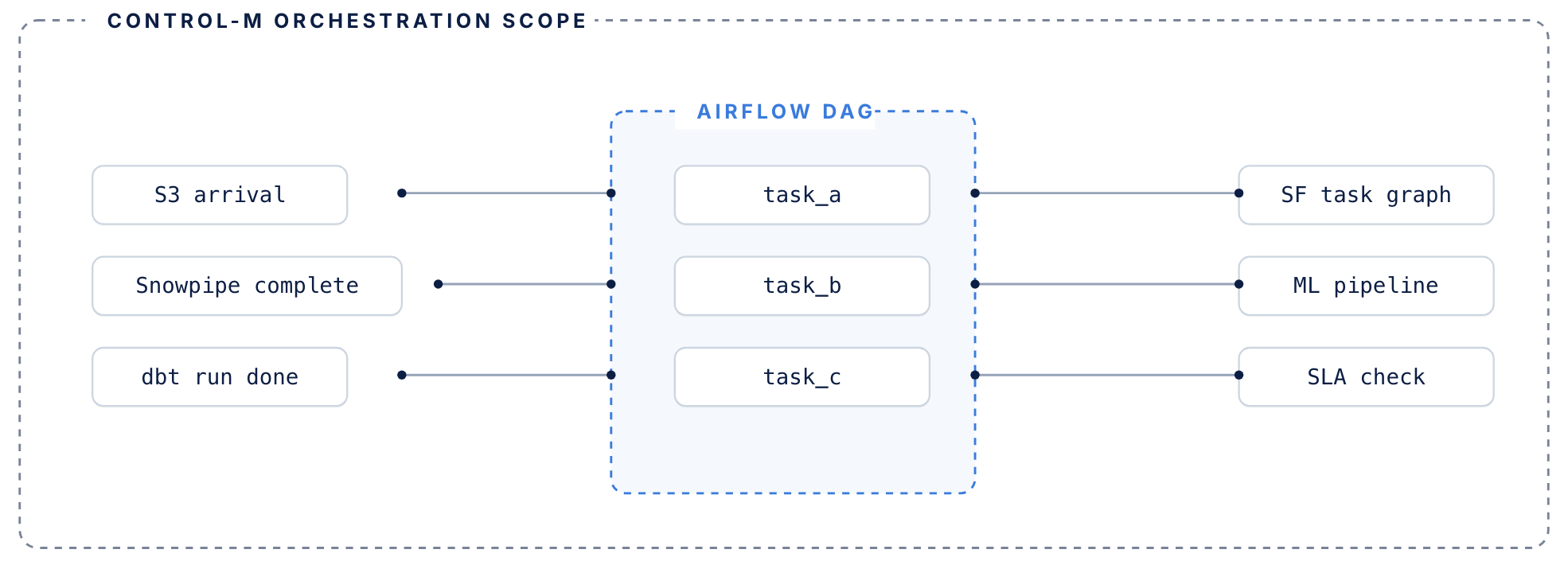
Airflow manages its DAG. Control-M manages everything surrounding it.
airflow handles
DAG-level orchestration inside the data pipeline
- DAG-level task orchestration within data pipelines
- Python operators, sensors, and task dependencies
- Execution graph for jobs that run inside your pipeline
- Manages retries within a single DAG context
control-m adds
The coordination layer around your DAGs
- Coordination layer around DAGs — triggers Airflow based on upstream conditions: file arrivals, API events, other tool completions
- Tracks each DAG’s SLA contribution across the full end-to-end workflow, not just its own routine
- Manages failure recovery when upstream dependencies fail before Airflow even starts
- Existing DAGs don’t need to be rewritten or migrated
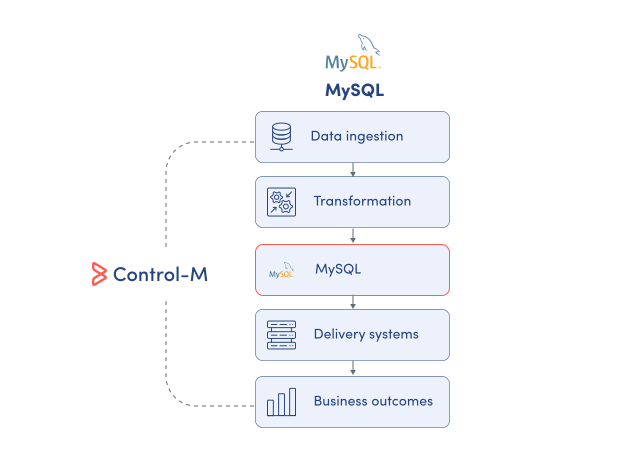
MONITOR PIPELINES
Monitor MySQL execution across the entire data pipeline
MySQL exposes database-level execution information, but production pipelines extend across ingestion, transformation, and delivery systems. Control-M brings those stages into one operational view so teams can monitor the complete workflow:
-
Database job execution status
-
Job duration and runtime history
-
Upstream and downstream dependencies
-
SQL execution output and stored-procedure return values
-
End-to-end workflow status
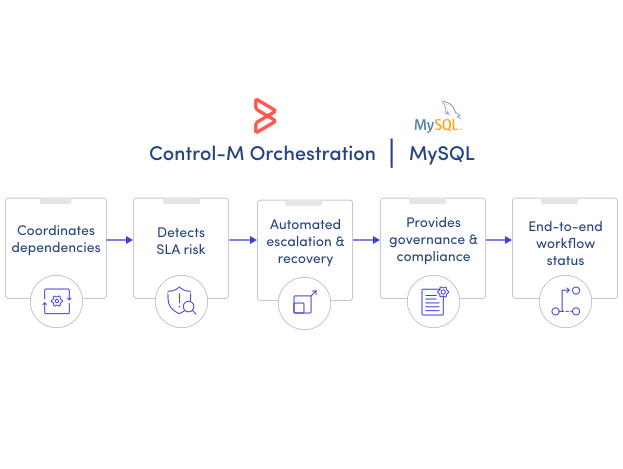
SLA ASSURANCE
Keep MySQL processing aligned with delivery deadlines
A successful SQL job can still be too late for the business process it supports. Control-M tracks MySQL processing within the complete service, helping teams identify delays before downstream reporting or analytics deadlines are missed:
-
End-to-end SLA tracking
-
SLA risk visibility
-
Dependency impact identification
-
Automated failure handling
-
Centralized operational alerts