Let us know how we can help
Sales & Pricing
Speak to a rep about your business needs

Help & Support
See our product support options
General inquiries and locations
Contact us


 Control-M + Microsoft MSSQL
Your Microsoft MSSQL workflow starts before a stored procedure ever executes — and it can fail when something upstream breaks. An Azure Blob Storage extract arrives late. An SSIS package misses its overnight processing window. Control-M orchestrates the full chain: Azure Blob file arrival, SSIS transformation, Microsoft MSSQL execution, and downstream analytics delivery.
common workflow issues
Does this sound like your week?
LATE FILE ARRIVAL
Your 2:00 AM Azure Blob extract is late. SQL starts anyway.
Control-M makes the MSSQL job dependent on the actual upstream file arrival instead of an independent schedule. The stored procedure starts only when its prerequisite is satisfied — preventing incomplete data from entering the database workflow.
SSIS FAILURE
Your SSIS package failed. The downstream stored procedure is still waiting.
Control-M monitors the SSIS package as part of the end-to-end workflow, detects its completion status, and controls downstream dependencies accordingly. Failed processing does not silently release dependent MSSQL work — containing the failure before it propagates.
CONNECTION FAILURE
SQL Server drops its connection. Your overnight pipeline stops at 3:17 AM.
Control-M applies configurable connection retry counts and retry timeouts when the database connection fails. Instead of immediately requiring manual intervention, transient connectivity problems can be retried automatically — keeping overnight processing moving when SQL Server becomes reachable again.
CROSS-TOOL DEPENDENCY
Your stored procedure finished. Power BI refresh is still on yesterday’s data.
Control-M connects MSSQL execution to downstream processing in the same workflow. Completion of the database step becomes an explicit dependency for the next job — replacing disconnected schedules with an orchestrated handoff across the data pipeline.
SLA RISK
Every SQL job succeeded. Your 6:00 AM analytics delivery still missed SLA.
Control-M tracks MSSQL processing inside the end-to-end workflow rather than treating database completion as the final outcome. Teams can monitor dependencies and SLA commitments across the complete processing chain — exposing delivery risk before the business deadline is missed.
Control‑M + Microsoft MSSQL
Control‑M + Microsoft MSSQL
|
workload.types |
Stored Procedures · SQL Scripts · Embedded Queries · SSIS Packages · MSSQL Agent Jobs |
|
trigger.type |
file arrival · upstream job completion · time schedule · Control-M event · cross-workflow dependency |
|
cross_tool.deps |
SSIS package completion · Azure Blob file arrival · Power BI refresh · Airflow DAG · REST API call · file delivery confirmation |
|
cloud.platforms |
Microsoft SQL Server · Microsoft Azure · hybrid environments · Control-M SaaS · on-premises Control-M |
|
error_handling |
connection retries (1–24 attempts) · connection retry timeout (1–300 seconds) · dependency failure handling · downstream cascade prevention · job rerun · SLA monitoring |
|
throughput |
concurrent database connections · 1–512 connection limit · parallel database jobs · centralized connection profiles · remote database execution |
|
observability |
job execution status · job output · dependency visibility · SLA tracking · centralized workflow monitoring · execution history |
end-to-end orchestration
One production workflow. Every tool in the stack.
Control-M orchestrates workflows across Microsoft MSSQL, SSIS, Airflow, Azure Blob Storage, Power BI, and file transfers in a single job flow — with dependency tracking, SLA visibility, and automated recovery across all of them.
- Cross-tool dependency: Azure Blob → SSIS → MSSQL stored procedure → Power BI refresh
- Data-aware triggers: file arrival, API event, SSIS completion, query result
|
Microsoft MSSQL |
Stored Procedures · SQL Scripts · Embedded Queries · database execution |
|
SSIS |
package execution · package dependencies · workflow coordination |
|
Azure Blob Storage |
file arrival · upstream data dependency · transfer coordination |
|
Apache Airflow |
DAG trigger · status tracking · cross-workflow dependency |
|
Power BI |
dataset refresh · downstream analytics handoff · workflow coordination |
|
File transfers |
managed transfer · arrival detection · delivery confirmation |
airflow coexistance
Control‑M doesn’t replace your Airflow DAGs. It runs the layer above them.
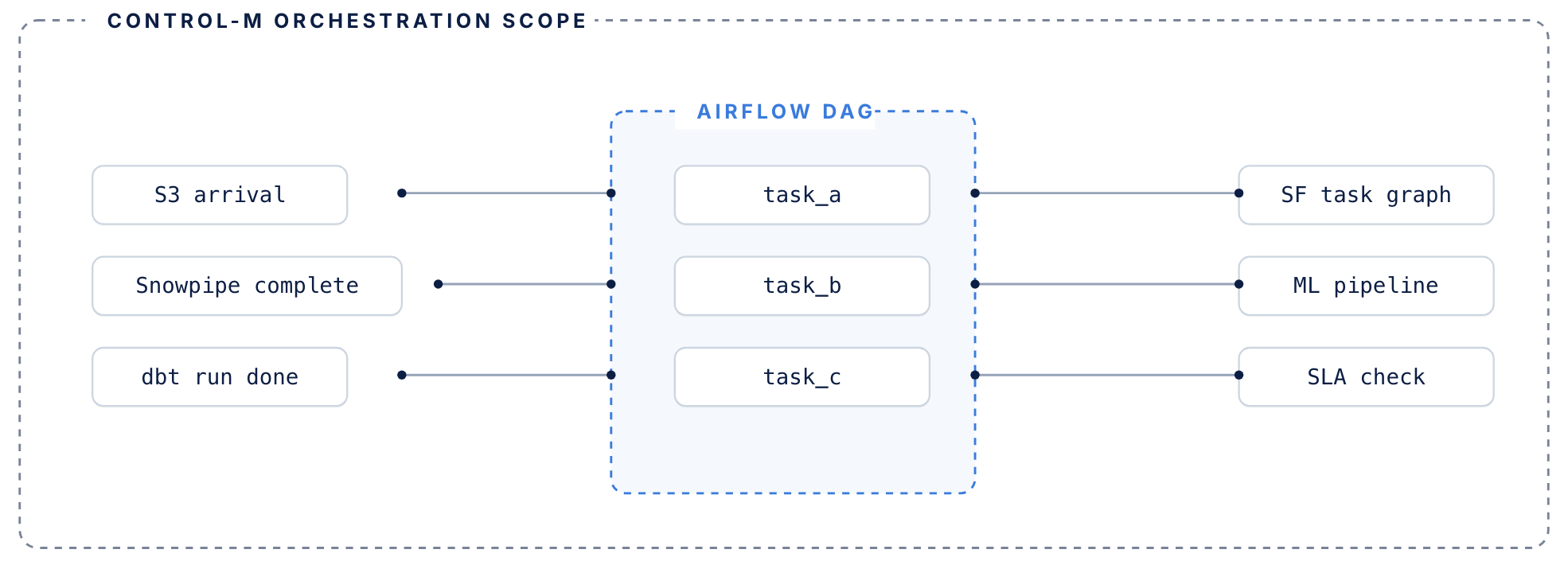
Airflow manages its DAG. Control-M manages everything surrounding it.
airflow handles
DAG-level orchestration inside the data pipeline
- DAG-level task orchestration within data pipelines
- Python operators, sensors, and task dependencies
- Execution graph for jobs that run inside your pipeline
- Manages retries within a single DAG context
control-m adds
The coordination layer around your DAGs
- Coordination layer around DAGs — triggers Airflow based on upstream conditions: file arrivals, API events, other tool completions
- Tracks each DAG’s SLA contribution across the full end-to-end workflow, not just its own routine
- Manages failure recovery when upstream dependencies fail before Airflow even starts
- Existing DAGs don’t need to be rewritten or migrated
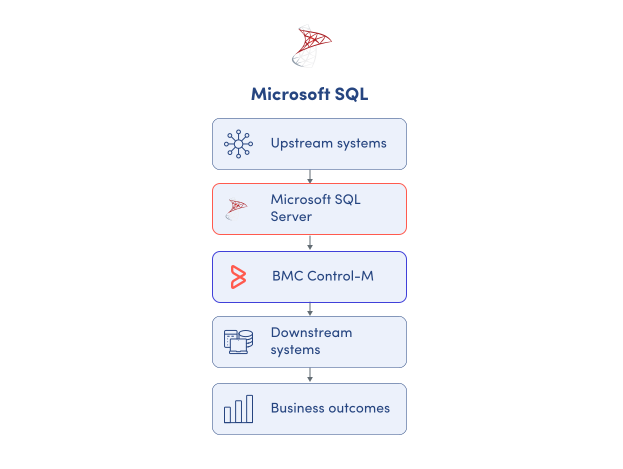
MONITOR PIPELINES
Monitor MSSQL jobs across the complete data pipeline.
SQL Server shows what happened inside the database, but data teams still need visibility across the systems surrounding it. Control-M centralizes MSSQL execution with upstream and downstream workflow context so teams can monitor the complete pipeline:
-
Database job execution status
-
Job output and runtime
-
Upstream and downstream dependencies
-
Cross-platform workflow status
-
SLA risk visibility
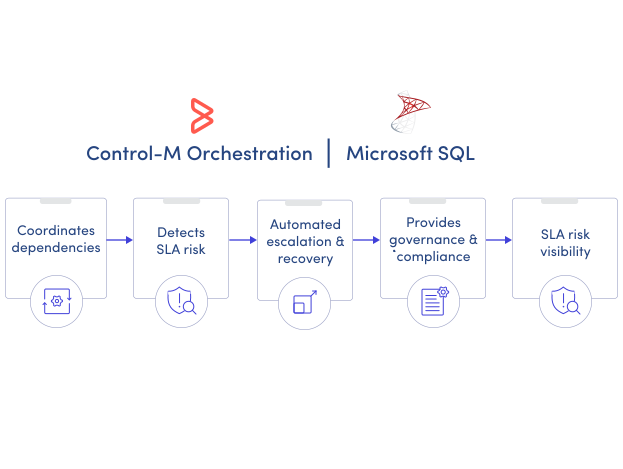
SLA ASSURANCE
Keep MSSQL pipelines aligned to business delivery SLAs.
A successful stored procedure does not mean the complete data product arrived on time. Control-M manages MSSQL jobs within their end-to-end dependency chain, helping teams track whether the overall workflow remains aligned to its delivery commitment:
-
End-to-end SLA tracking
-
Cross-tool dependency visibility
-
Workflow completion monitoring
-
Failed dependency containment
-
Centralized exception management
