Let us know how we can help
Sales & Pricing
Speak to a rep about your business needs

Help & Support
See our product support options
General inquiries and locations
Contact us


 Control-M + Microsoft Azure Backup
Your Azure Backup workflow starts before a backup or restore job ever executes — and it can fail when something upstream breaks. An Azure Data Factory pipeline misses its completion window. An Azure Automation runbook overruns the maintenance window. Control-M orchestrates the full chain: workload preparation, application quiescence, Azure Backup execution, and downstream validation.
common workflow issues
Does this sound like your week?
These aren’t edge cases. They’re the normal operating conditions for teams running Azure Backup jobs across multiple tools. Here’s how Control-M handles each one.
BACKUP READINESS
Your 2:00 a.m. backup starts. The upstream application job is still running.
Control-M makes Azure Backup execution dependent on the upstream workload completing successfully. The backup waits for the required Control-M conditions instead of starting against an active application state — keeping backup activity aligned with the production workflow.
RESTORE CONTROL
Recovery is urgent. The wrong recovery point cannot be an option.
Control-M can run an Azure Backup restore from a specified recovery point, with the target storage account, restore region, and disk list defined in the job — making recovery execution repeatable and controlled.
FAILURE DETECTION
Azure accepted the request. Five minutes later, the operation still hasn’t completed.
Azure Backup operations are asynchronous. Control-M polls job status at a configurable frequency and applies a defined failure tolerance, surfacing the final execution state to the workflow so dependent jobs do not proceed on an incomplete backup.
DISK SCOPE
The VM needs protection. Temporary disks don’t belong in this backup.
Control-M Azure Backup jobs can explicitly include or exclude disk LUNs when the backup runs. Operations teams define the required disk list in the job instead of relying on manual intervention at execution time.
SLA RISK
The backup completed. The overnight service window still missed its deadline.
Control-M attaches Azure Backup execution to the wider service workflow and can apply SLA management across its dependencies. Teams see deadline risk in business-service context instead of treating a technically successful backup as proof the end-to-end process finished on time.
INTEGRATION FACTS
Control‑M + Microsoft Azure Backup
|
Platform & OS coverage |
Microsoft Azure · Azure Backup · Azure virtual machines · Linux Control-M Agent · Windows Control-M Agent · Control-M SaaS |
|
Job types supported |
Azure Backup job · Backup · Restore from Backup · disk-scoped backup (include/exclude disk LUNs) · recovery-point restore (specified Recovery Point Name) |
|
SLA monitoring & alerting |
SLA Management job · critical-path monitoring · predicted SLA delay · service deadline tracking · job-failure actions · automated notification |
|
Audit trail & access controls |
centralized connection profiles · Service Principal authentication · Managed Identity authentication · Microsoft Entra ID · external-vault support · Control-M role-based access |
end-to-end orchestration
One production workflow. Every tool in the stack.
Control-M orchestrates workflows across Azure Backup, Azure Data Factory, Azure Automation, Azure Functions, file transfers, and enterprise applications in a single job flow — with dependency tracking, SLA visibility, and automated recovery across all of them.
- Cross-tool dependency: Azure Data Factory → application quiescence → Azure Backup → validation
- Data-aware triggers: file arrival, API event, upstream job completion, backup completion
|
Microsoft Azure Backup |
backup · restore from backup · disk selection · recovery-point selection · status monitoring |
|
Azure Data Factory |
pipeline execution · dependency orchestration · status tracking |
|
Azure Automation |
runbook coordination · prerequisite sequencing · downstream dependency control |
|
Azure Functions |
function execution · event-driven workflow coordination · status handling |
|
Control-M MFT |
managed file transfer · arrival dependencies · delivery confirmation |
|
ServiceNow |
incident workflow integration · operational handoff · service-management coordination |
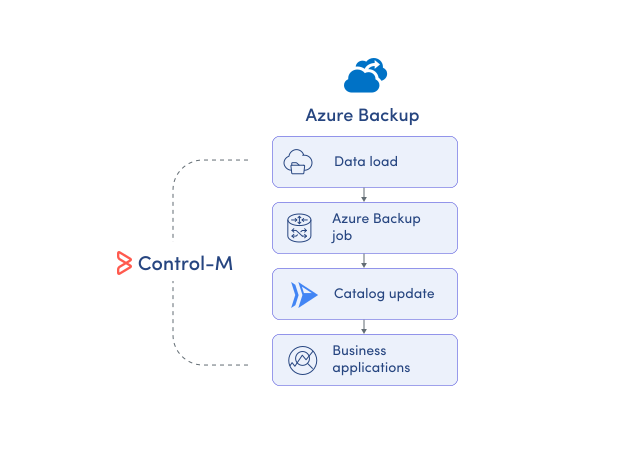
MONITOR BACKUPS
Monitor Azure Backup inside the complete workflow.
Azure Backup exposes backup-job state, but operations teams still need to understand what happened before and what depends on it afterward. Control-M puts Azure Backup status, results, output, and surrounding workflow dependencies into one operational view:
-
Azure Backup execution status
-
Job results and output
-
Upstream and downstream dependencies
-
Runtime and completion visibility
-
Cross-platform workflow monitoring
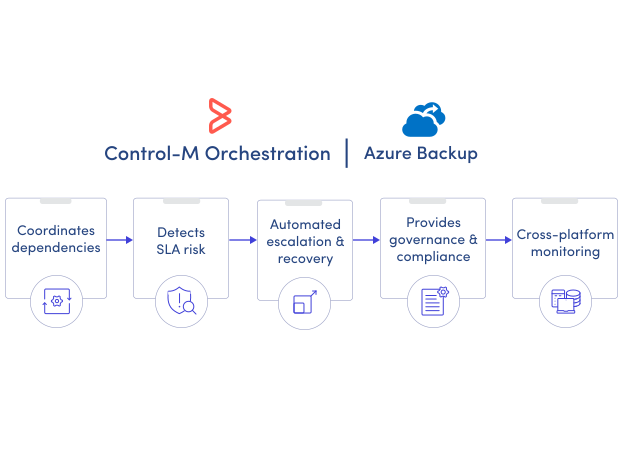
SLA ASSURANCE
Keep backup-dependent services inside their SLA windows.
A successful backup does not guarantee the surrounding business service finished on time. Control-M can attach SLA management to Azure Backup workflows, monitor their critical path, identify problematic jobs, and surface predicted delays before the service deadline is missed:
-
SLA deadline tracking
-
Critical-path visibility
-
Predicted delay detection
-
Problematic-job identification
-
Automated service actions
Documentation
Bring order to complex workflows
Learn how Control-M helps teams orchestrate complex processes with greater visibility, coordination, and control.
