Let us know how we can help
Sales & Pricing
Speak to a rep about your business needs

Help & Support
See our product support options
General inquiries and locations
Contact us


 Control-M + Impala
Your Impala workflow starts before an SQL query ever executes — and it can fail when something upstream breaks. An HDFS data file arrives late or below its expected size. A Spark transformation finishes after the analytics window. Control-M orchestrates the full chain: HDFS data arrival, Spark transformation, Impala query execution, and downstream analytics delivery — using the Control-M for Hadoop plug-in.
common workflow issues
Does this sound like your week?
LATE HDFS DATA
Your 6:00 AM Impala query started. Yesterday’s HDFS partition hasn’t landed.
Control-M uses HDFS File Watcher criteria to wait for the required file and minimum size before releasing the Impala job. The query runs against ready data instead of starting on schedule with an incomplete input.
SPARK · IMPALA
Your Spark transformation finished late. The Impala query window already passed.
Control-M links Spark completion directly to Impala execution through workflow dependencies. When Spark ends successfully, the downstream Impala job becomes eligible to run — eliminating disconnected schedules and reducing unnecessary waiting.
QUERY FAILURE
The Impala SQL failed. Downstream analytics jobs are still queued to run.
Control-M detects the failed job state and prevents dependent workflow steps from proceeding. Recovery actions and rerun logic can be applied before downstream processing resumes, containing the failure instead of propagating incomplete results.
HIVE · IMPALA
Hive changed the data. Your Impala reporting query ran too early.
Control-M coordinates Hive and Impala jobs inside the same production workflow, enforcing completion dependencies before query execution. The analytics step runs only after its upstream processing completes, replacing loosely coordinated schedules with explicit workflow sequencing.
SLA RISK
A long-running Impala query is putting the morning analytics handoff at risk.
Control-M tracks the Impala job as part of the complete business workflow and applies SLA monitoring across dependent steps. Teams can identify deadline risk before the final delivery is late and intervene where the delay originates.
INTEGRATION FACTS
Control‑M + Impala
|
workload.types |
Impala Open Query · Impala Query File · SQL query execution · Impala command-line options · SELECT queries · INSERT operations · DDL statements |
|
trigger.type |
HDFS file arrival · minimum file size · time schedule · upstream Spark completion · upstream Hive completion · upstream job status |
|
cross_tool.deps |
HDFS File Watcher · Spark job · Hive job · Sqoop job · HDFS Commands · downstream analytics job · file delivery |
|
cloud.platforms |
Hadoop clusters · Cloudera environments · HDFS · Control-M SaaS · Control-M self-hosted |
|
error_handling |
upstream failure gating · downstream cascade prevention · job rerun · pre-command failure handling · post-command failure handling · SLA alerting |
|
throughput |
distributed SQL analytics · large-scale Hadoop datasets · parallel Impala queries · batch analytics pipelines · high-volume query workloads |
|
observability |
job execution status · job output · dependency visibility · runtime history · SLA monitoring · end-to-end workflow status |
end-to-end orchestration
One production workflow. Every tool in the stack.
Control-M orchestrates workflows across Impala, HDFS, Spark, Hive, Sqoop, file transfers, and cloud services in a single job flow — with dependency tracking, SLA visibility, and automated recovery across all of them.
- Cross-tool dependency: HDFS file arrival → Spark transformation → Impala query → analytics handoff
- Data-aware triggers: HDFS file arrival, minimum file size, Spark completion, Hive completion
|
Impala |
Open Query execution · Query File execution · command-line options · dependency management |
|
HDFS |
file watching · minimum-size criteria · file detection · HDFS commands |
|
Spark |
Python execution · Scala/Java applications · application arguments · dependency coordination |
|
Hive |
script execution · script parameters · workflow dependencies · execution monitoring |
|
Sqoop |
command execution · properties · file dependencies · workflow sequencing |
|
Managed File Transfer |
file delivery · transfer dependencies · arrival-driven processing · downstream handoff |
|
Cloud services |
cross-platform dependencies · workflow coordination · scheduling · SLA visibility |
airflow coexistance
Control-M doesn’t replace your Airflow DAGs. It runs the layer above them.
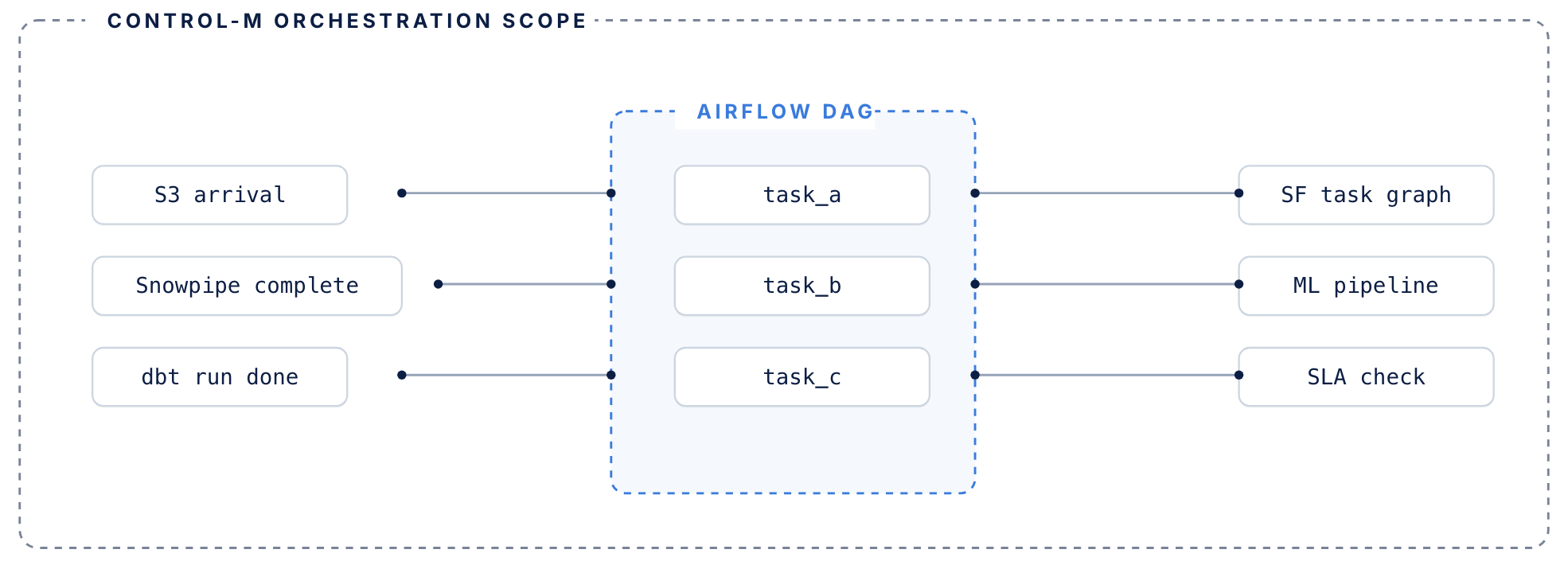
Airflow manages its DAG. Control-M manages everything surrounding it.
AIRFLOW HANDLES
DAG-level orchestration inside the data pipeline
- DAG-level task orchestration within data pipelines
- Python operators, sensors, and task dependencies
- Execution graph for jobs that run inside your pipeline
- Manages retries within a single DAG context
control-m adds
The coordination layer around your DAGs
- Coordination layer around DAGs — triggers Airflow based on upstream conditions: file arrivals, API events, other tool completions
- Tracks each DAG’s SLA contribution across the full end-to-end workflow, not just its own routine
- Manages failure recovery when upstream dependencies fail before Airflow even starts
- Existing DAGs don’t need to be rewritten or migrated
MONITOR PIPELINES
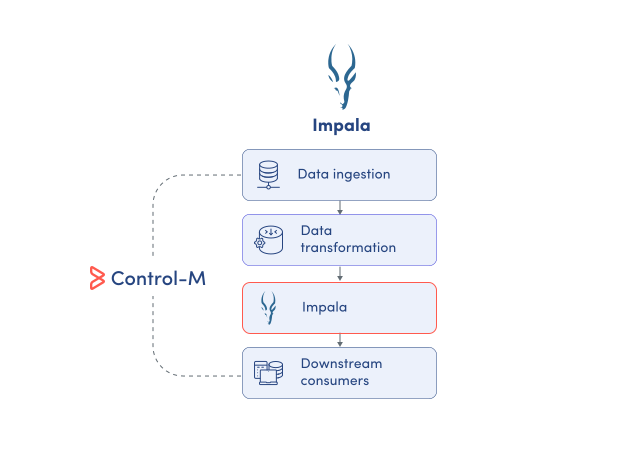
Monitor Impala execution across the entire data pipeline.
Impala exposes query execution within the Hadoop environment, but production delivery depends on upstream ingestion, transformation, and downstream consumers. Control-M provides operational visibility across those connected workflow stages so teams can see execution in context:
-
Impala job execution status
-
Runtime and execution history
-
Upstream and downstream dependencies
-
Job output and failures
-
End-to-end workflow status
SLA ASSURANCE
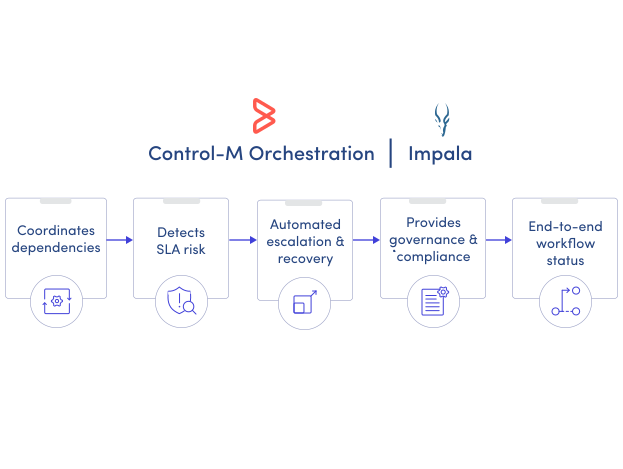
Keep Impala analytics delivery commitments on track.
Impala executes SQL quickly, but query performance alone cannot guarantee an end-to-end delivery deadline. Control-M tracks the surrounding workflow, exposes dependency delays, and coordinates recovery when upstream processing threatens the required analytics delivery time:
-
End-to-end SLA monitoring
-
Upstream delay visibility
-
Failure-driven downstream holds
-
Automated recovery workflows
-
Business delivery status
