Let us know how we can help
Sales & Pricing
Speak to a rep about your business needs

Help & Support
See our product support options
General inquiries and locations
Contact us


 Control-M + Hadoop HDFS
Your Hadoop HDFS workflow starts before an HDFS command or file watcher ever executes — and it can fail when something upstream breaks. A Sqoop import never writes its expected HDFS dataset. A Hive transformation finishes late and misses the downstream processing window. Control-M orchestrates the full chain: source data arrival, Hive transformation, HDFS execution, and downstream delivery.
common workflow issues
Does this sound like your week?
FILE ARRIVAL
The HDFS file arrived at 2:00 a.m. It’s still incomplete.
Control-M HDFS File Watcher waits for the specified HDFS path until the file reaches the defined minimum size. If the file arrives but the size criteria isn't met, the job continues watching, preventing partial data from entering the next pipeline stage.
HDFS COMMAND FAILURE
Your HDFS get failed. Downstream processing is already scheduled to start.
Control-M executes HDFS commands as managed jobs and captures their completion state. Dependencies prevent downstream jobs from proceeding after a failed command, keeping an HDFS access or transfer problem from cascading through the rest of the workflow.
CROSS-CLUSTER COPY
Yesterday’s DistCp transfer ran long. Today’s analytics window is closing.
Control-M schedules DistCp as part of the same production workflow, tracks its completion before dependent processing begins, and applies Control-M scheduling and SLA controls around the job — reducing manual coordination when large inter-cluster copies run long.
HIVE · HDFS
Your Hive job finished. The HDFS delivery step never started.
Control-M models Hive processing and HDFS operations within one dependency chain. When the Hive job reaches its required completion state, Control-M can release the dependent HDFS step without a separate cron schedule or manual handoff.
SLA RISK
HDFS processing is delayed. The business deadline hasn’t moved.
Control-M brings Hadoop jobs into its enterprise scheduling environment and enables SLA jobs around them. Teams can manage the HDFS stage in the context of the end-to-end workflow instead of troubleshooting an isolated filesystem task.
INTEGRATION FACTS
Control‑M + Hadoop HDFS
|
workload.types |
HDFS Commands · HDFS File Watcher · DistCp · Spark pre/post HDFS commands · MapReduce pre/post HDFS commands |
|
trigger.type |
HDFS file arrival (with minimum file size and maximum wait time criteria) · time schedule · upstream job completion. |
|
cross_tool.deps |
Hive job · Spark job · Sqoop job · MapReduce job · Oozie workflow · DistCp transfer · downstream analytics |
|
cloud.platforms |
on-premises Hadoop · Cloudera / Hortonworks distributions · Linux edge node · Kerberos-secured Hadoop |
|
error_handling |
pre-command failure handling (FailJobOnCommandFailure) · post-command failure handling · dependency gating · SLA monitoring · resource controls |
|
throughput |
distributed HDFS storage · large data sets · parallel DistCp transfers · Hadoop batch processing · cluster-scale workloads |
|
observability |
Control-M job monitoring · job completion status · end-to-end dependency visibility · SLA tracking · centralized scheduling view |
end-to-end orchestration
One production workflow. Every tool in the stack.
Control-M orchestrates workflows across Hadoop HDFS, Hive, Spark, Sqoop, Oozie, and file transfers in a single job flow — with dependency tracking, SLA visibility, and automated recovery across all of them.
- Cross-tool dependency: Sqoop → HDFS → Hive → Spark
- Data-aware triggers: HDFS file arrival, minimum file size, job completion, time schedule
|
Hadoop HDFS |
HDFS commands · file arrival watching · minimum-size criteria · managed dependencies |
|
DistCp |
distributed copy · source paths · target path · DistCp options |
|
Hive |
Hive script execution · dependency coordination · pre/post HDFS operations |
|
Spark |
distributed copy (inter/intra-cluster) · source paths · target path · DistCp options. |
|
Sqoop |
data movement jobs · workflow dependencies · scheduled execution |
|
Oozie |
workflow execution · workflow extraction · action visibility |
|
MapReduce |
MapReduce jobs · streaming jobs · HDFS pre/post commands |
MONITOR PIPELINES
Monitor HDFS execution across the complete data pipeline
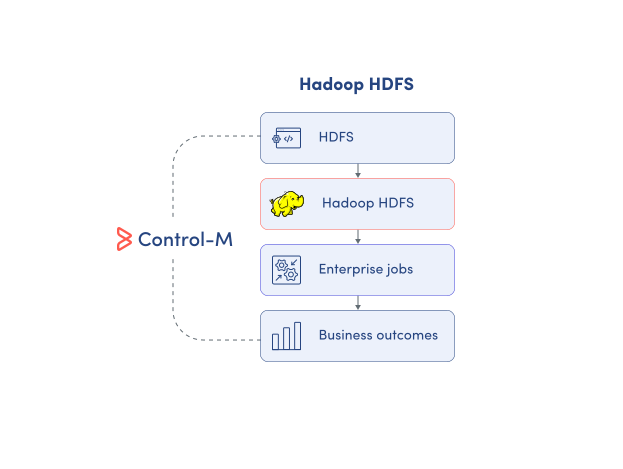
HDFS shows what is happening inside the filesystem, but not whether the complete business workflow is progressing. Control-M puts HDFS operations alongside Hadoop processing and dependent enterprise jobs in one operational view:
-
HDFS job execution status
-
Upstream and downstream dependencies
-
Cross-tool workflow visibility
-
Centralized job monitoring
SLA ASSURANCE
Keep HDFS-dependent pipelines aligned to business deadlines
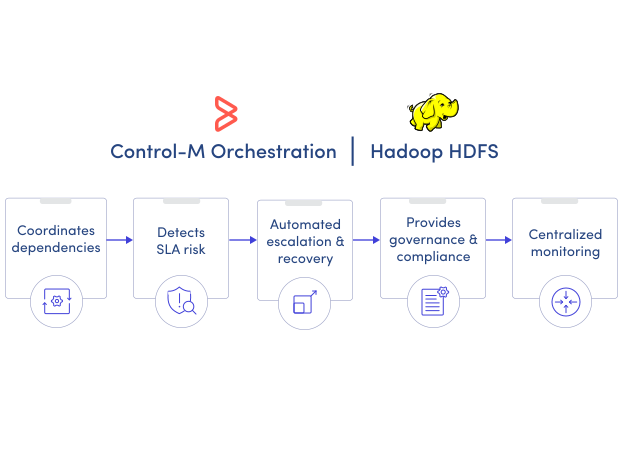
A successful HDFS operation can still be too late for the process that depends on it. Control-M applies enterprise scheduling, dependencies, resource controls, and SLA management around Hadoop workloads so teams can manage delivery in business context:
-
End-to-end SLA tracking
-
Advanced scheduling criteria
-
Complex dependency management
-
Resource pool coordination
-
Lock resource controls
