Let us know how we can help
Sales & Pricing
Speak to a rep about your business needs

Help & Support
See our product support options
General inquiries and locations
Contact us


 Control-M + GCP Functions
Your GCP Functions workflow starts before an HTTP function invocation ever executes — and it can fail when something upstream breaks. A Google Cloud Storage object arrives late. A GCP Dataflow job misses its processing window. Control-M orchestrates the full chain: Google Cloud Storage arrival, GCP Dataflow processing, GCP Functions execution, and downstream delivery.
common workflow issues
Does this sound like your week?
These aren’t edge cases. They’re the normal operating conditions for teams running GCP Functions workflows across multiple tools. Here’s how Control-M handles each one.
UPSTREAM DEPENDENCY
Your Dataflow job finished late. The function still cannot safely run.
Control-M tracks the upstream GCP Dataflow job as an explicit dependency and releases the GCP Functions job only when its prerequisite completes successfully — keeping execution order deterministic instead of relying on disconnected schedules or manual intervention.
INVOCATION FAILURE
The function was invoked. Production is waiting on the result.
Control-M polls the GCP Functions job status at a configurable frequency, applies failure tolerance, and reflects the resulting job state in the wider workflow — preventing dependent production steps from continuing after an unsuccessful invocation..
AUTHENTICATION FAILURE
An IAM change lands. Your 2 a.m. function invocation stops cold.
Control-M uses a managed GCP Functions connection profile with Service Account or IAM authentication. Credentials can be retrieved through an external vault, separating orchestration logic from secrets and making authentication failures easier to isolate operationally.
TROUBLESHOOTING DELAY
The function failed. Now three teams are hunting for context.
Control-M can retrieve GCP Functions logs into job output while exposing status, results, and surrounding workflow dependencies in the same operational view — giving responders execution context without reconstructing the end-to-end sequence across separate consoles.
SLA RISK
The function succeeded at 05:42. The business deadline still slipped.
Control-M attaches the GCP Functions job to the end-to-end service SLA instead of treating function success as the finish line. Teams can see its contribution to the broader workflow and respond before downstream delivery misses its target.
Control‑M + GCP Functions
Control‑M + GCP Functions
|
API and automation capabilities |
Job:GCP Functions · Automation API REST API · Automation API CLI · JSON job definitions · URL parameters · JSON body parameters · Cloud Functions API V1 · Cloud Functions API V2 |
|
Deployment models & infrastructure flexibility |
Control-M SaaS · Linux Agent plug-in · Windows Agent plug-in · centralized connection profiles · GCP Functions endpoints · Automation API provisioning (ctm provision image) · Agent 9.0.21.000+ |
|
Security posture |
GCP Service Account authentication · IAM role authentication · secure connection profiles · external vault integration · service account keys · GCP Access Control (Service Account / IAM) · HTTPS API endpoint |
|
Incident response & MTTR enablement |
configurable status polling · failure tolerance · function log retrieval · job status and output · cross-workflow dependency control · SLA job attachment |
end-to-end orchestration
One production workflow. Every tool in the stack.
Control-M orchestrates workflows across GCP Functions, GCP Workflows, GCP Dataflow, BigQuery, Google Cloud Storage, and GCP Composer in a single job flow — with dependency tracking, SLA visibility, and automated recovery across all of them.
- Cross-tool dependency: Google Cloud Storage → GCP Dataflow → GCP Functions → GCP Workflows
- Data-aware triggers: Google Cloud Storage object arrival, API event, GCP Dataflow completion, upstream job exit state
|
GCP Functions |
function invocation · URL/body parameters · API V1/V2 · status polling · log retrieval |
|
GCP Workflows |
workflow execution · JSON parameters · execution status · workflow results · dependency coordination |
|
GCP Dataflow |
Classic/Flex template execution · job monitoring · output retrieval · SLA coordination |
|
BigQuery |
query execution · table loads · extracts · routines · workflow dependencies |
|
Google Cloud Storage |
object watch · cloud file transfer · arrival dependency · managed delivery |
|
GCP Composer |
DAG execution · parameters · task output · DAG status tracking |
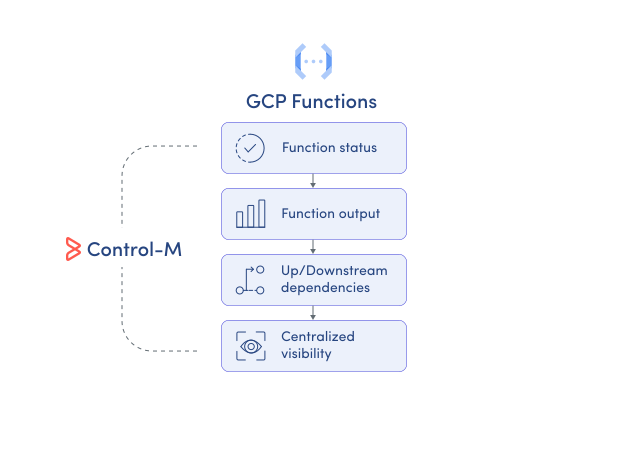
MONITOR WORKFLOWS
See GCP Functions execution in full workflow context
Google Cloud exposes function-level execution information, but production incidents rarely stop at one service boundary. Control-M brings GCP Functions status, results, output, and surrounding dependencies into the operational workflow view so teams can quickly establish what ran and what waits next:
-
Function execution status
-
Function results and output
-
Upstream and downstream dependencies
-
Centralized operational workflow visibility
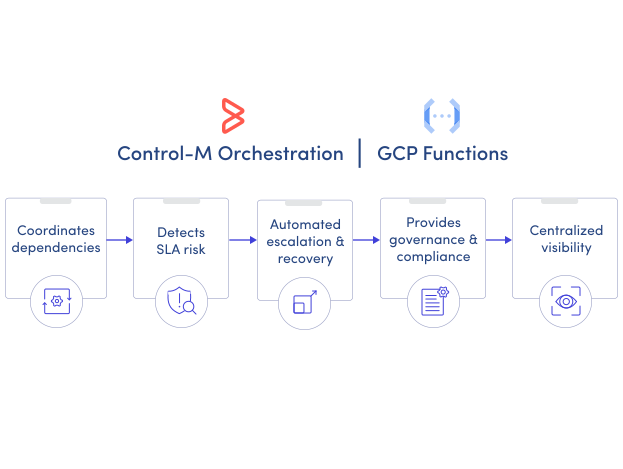
SLA ASSURANCE
Manage GCP Functions against end-to-end service deadlines
A successful function invocation does not prove the business service will finish on time. Control-M connects GCP Functions execution to the broader service SLA, giving operations teams the workflow-level context needed to identify delays before downstream delivery is affected:
-
End-to-end SLA tracking
-
Predictive SLA delay detection
-
Cross-platform dependency visibility
-
Automated failure handling
Documentation
Bring order to complex workflows
Learn how Control-M helps teams orchestrate complex processes with greater visibility, coordination, and control.
