Let us know how we can help
Sales & Pricing
Speak to a rep about your business needs

Help & Support
See our product support options
General inquiries and locations
Contact us


 Control-M + DB2
Your DB2 workflow starts before an SQL script or stored procedure ever executes — and it can fail when something upstream breaks. An IBM DataStage job fails before loading its staging tables. An Apache Spark transformation overruns its nightly processing window. Control-M orchestrates the full chain: source data arrival, upstream transformation, DB2 execution, and downstream delivery.
common workflow issues
Does this sound like your week?
LATE DATA
The DataStage job finished late. Your DB2 SQL ran at 2:00 anyway.
Control-M replaces disconnected schedules with explicit dependencies. It waits for the upstream DataStage job to complete successfully before releasing the DB2 SQL job, preventing incomplete inputs from propagating into downstream processing.
SQL FAILURE
Your DB2 SQL script failed. Downstream reporting is still waiting.
Control-M detects the database job’s completion status, keeps dependent jobs from running after a failure, and exposes the failed step within the end-to-end workflow so teams can recover processing without tracing separate schedules.
CONNECTION FAILURE
DB2 was unavailable at 1:15 AM. The batch window kept moving.
Control-M supports automatic job rerun with configurable retry counts and intervals. Transient failures can trigger an automated rerun instead of immediately failing the workflow, reducing manual intervention during unattended overnight processing.
CROSS-TOOL DEPENDENCY
Spark finished at 3:07 AM. DB2 is still waiting on cron.
Control-M models Spark and DB2 processing in the same workflow, evaluates the upstream completion dependency, and releases database execution when processing is actually ready — eliminating unnecessary waits created by fixed time schedules.
SLA RISK
The DB2 load is running long. Your 6:00 AM handoff is at risk.
Control-M tracks the database job as part of the end-to-end service, applies SLA management across dependent processing, and surfaces delays in context so teams can act before late DB2 processing compromises downstream delivery.
INTEGRATION FACTS
Control‑M + DB2
|
workload.types |
Stored Procedures · SQL Scripts · Embedded Queries · parameterized stored procedures and scripts · batch database processing · data loads · database transformations |
|
trigger.type |
file arrival · upstream ETL completion · API/webhook · time schedule · business calendar · upstream job status |
|
cross_tool.deps |
IBM DataStage job · Apache Airflow DAG · Spark/Databricks job · Informatica workflow · REST API call · file delivery confirmation |
|
cloud.platforms |
AWS-connected workflows · Microsoft Azure-connected workflows · Google Cloud-connected workflows · on-premises · hybrid environments |
|
error_handling |
automatic job rerun with configurable retry intervals · downstream cascade prevention · automated job hold · rerun from point of failure · SLA alerting |
|
throughput |
high-volume batch · concurrent database jobs · parallel workflow execution · large-scale data loads · scheduled database processing |
|
observability |
database job status · execution logs · appended SQL output · dependency visibility · SLA monitoring · centralized workflow monitoring |
end-to-end orchestration
One production workflow. Every tool in the stack.
Control-M orchestrates workflows across DB2, IBM DataStage, Airflow, Spark, file transfers, and cloud services in a single job flow — with dependency tracking, SLA visibility, and automated recovery across all of them.
- Cross-tool dependency: IBM DataStage → DB2 SQL job → Spark → analytics handoff
- Data-aware triggers: file arrival, API event, ETL completion, database job completion
|
DB2 |
Stored Procedures · SQL Scripts · Embedded Queries · execution monitoring |
|
IBM DataStage |
ETL job execution · status tracking · dependency coordination |
|
Apache Airflow |
DAG triggering · status tracking · dependency coordination |
|
Spark / Databricks |
job execution · transformation dependencies · downstream handoff |
|
File transfers |
file arrival · transfer completion · workflow triggering |
|
Cloud services |
API execution · event-driven dependencies · cross-platform coordination |
|
Analytics platforms |
downstream refresh · delivery dependencies · SLA coordination |
airflow coexistance
Control-M doesn’t replace your Airflow DAGs. It runs the layer above them.
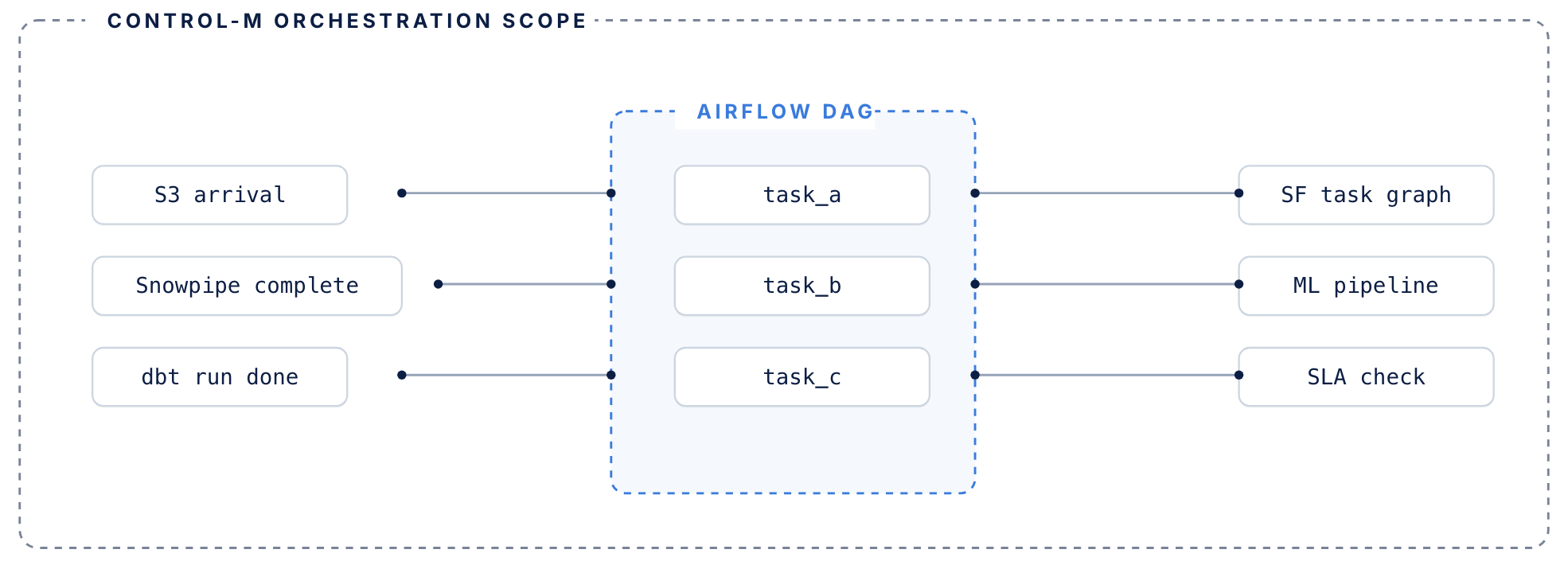
Airflow manages its DAG. Control-M manages everything surrounding it.
AIRFLOW HANDLES
DAG-level orchestration inside the data pipeline
- DAG-level task orchestration within data pipelines
- Python operators, sensors, and task dependencies
- Execution graph for jobs that run inside your pipeline
- Manages retries within a single DAG context
control-m adds
The coordination layer around your DAGs
- Coordination layer around DAGs — triggers Airflow based on upstream conditions: file arrivals, API events, other tool completions
- Tracks each DAG’s SLA contribution across the full end-to-end workflow, not just its own routine
- Manages failure recovery when upstream dependencies fail before Airflow even starts
- Existing DAGs don’t need to be rewritten or migrated
MONITOR PIPELINES
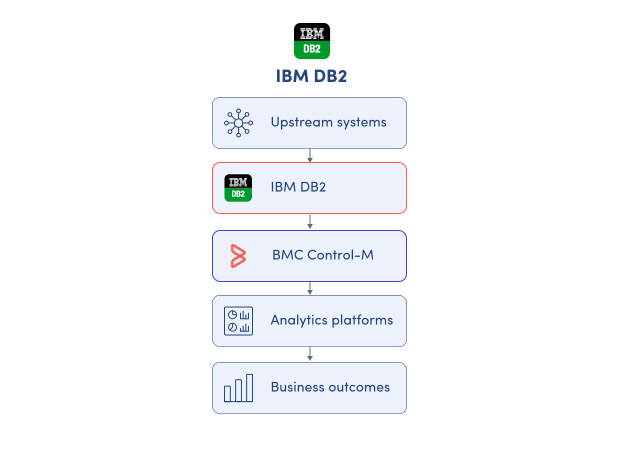
Monitor DB2 jobs across the entire data pipeline.
DB2 exposes database execution, but production pipelines often span ETL tools, files, APIs, and analytics platforms. Control-M provides centralized operational visibility across the complete workflow, helping data teams see execution and dependencies together:
-
Database job execution status
-
Upstream and downstream dependencies
-
Execution logs and SQL output
-
End-to-end workflow status
-
SLA risk visibility
SLA ASSURANCE
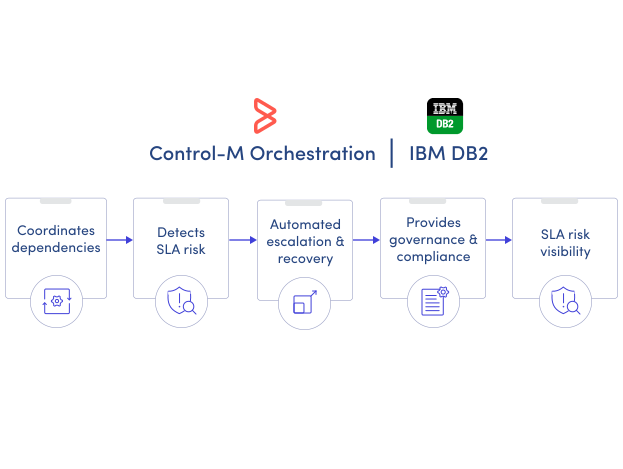
Keep DB2 data delivery commitments on track.
DB2 can execute database processing successfully while the broader data pipeline still misses its delivery window. Control-M connects database execution to upstream and downstream dependencies, giving teams workflow-level SLA visibility and coordinated recovery:
-
End-to-end SLA monitoring
-
Cross-platform dependency tracking
-
Automated failure recovery
-
Delay and exception visibility
-
Business service monitoring
