Let us know how we can help
Sales & Pricing
Speak to a rep about your business needs

Help & Support
See our product support options
General inquiries and locations
Contact us


 Control-M + Azure Service Bus
Your Azure Service Bus workflow starts before a message publish job ever runs — and it can fail when something upstream breaks. An Azure Blob hasn’t arrived. An Azure Function transformation ran long. Control-M orchestrates the full chain: Blob arrival, Azure Function transformation, Service Bus publishing, and downstream delivery.
common workflow issues
Does this sound like your week?
These aren’t edge cases. They’re the normal operating conditions for teams running Azure Service Bus messaging workflows across multiple tools. Here’s how Control-M handles each one.
UPSTREAM DEPENDENCY
The Blob arrived late. Your message was already scheduled to publish.
Control-M makes the Azure Service Bus job dependent on upstream completion instead of an isolated clock. The publish step runs only after required jobs and conditions are satisfied, preventing premature handoffs to queues or topics.
FUNCTION DELAY
Your Azure Function ran long. The queue handoff is still waiting.
Control-M tracks the upstream job dependency and releases the Azure Service Bus publish job only after successful completion. The workflow advances from processing to messaging without brittle timing assumptions or manual coordination between services.
PUBLISH FAILURE
The 2:13 AM message publish failed. Downstream processing never started.
Control-M monitors Azure Service Bus job status, results, and output within the wider workflow. Failed publishing can stop dependent jobs and invoke configured Control-M recovery and notification actions, containing the failure before it propagates downstream.
CROSS-TOOL HANDOFF
Kubernetes finished successfully. The Azure queue handoff never followed.
Control-M coordinates the dependency between Kubernetes workloads and Azure Service Bus jobs in one workflow. Successful upstream completion releases the message-publishing step automatically, replacing disconnected schedules and custom handoff scripts with an explicit production dependency.
SLA RISK
The workflow deadline is 7:00 AM. Messaging is already running late.
Control-M can attach SLA management to Azure Service Bus jobs and track them within the end-to-end workflow. Teams see messaging delays in business-service context and can respond before a late handoff threatens the delivery deadline.
Control‑M + Azure Service Bus
Control‑M + Azure Service Bus
|
API and automation capabilities |
Control-M Automation API · Job:Azure Service Bus · queue publishing · topic publishing · message body definition · JSON job definitions · centralized connection profiles |
|
Deployment models & infrastructure flexibility |
Control-M SaaS · Linux Agent plug-in · Windows Agent plug-in · Azure VM with Managed Identity · on-premises Agent with Service Principal · non-Azure cloud Agent with Service Principal |
|
Security posture |
Microsoft Entra authentication · Service Principal · Managed Identity · user-assigned Managed Identity client ID · centralized connection profiles · external vault integration · client-secret management |
|
Incident response & MTTR enablement |
job status monitoring · results and output visibility · dependency-based cascade prevention · Control-M recovery actions · notifications and alerts · SLA management · workflow-level monitoring |
end-to-end orchestration
One production workflow. Every tool in the stack.
Control-M orchestrates workflows across Azure Service Bus, Azure Functions, Kubernetes, Azure Blob Storage, Databricks, and file transfers in a single job flow — with dependency tracking, SLA visibility, and automated recovery across all of them.
- Cross-tool dependency: Kubernetes → Azure Function → Azure Service Bus → downstream consumer
- Data-aware triggers: file arrival, API event, upstream job completion, processing result
|
Azure Service Bus |
queue publishing · topic publishing · message formats · status/results/output monitoring · SLA attachment |
|
Azure Functions |
function execution · dependency control · status monitoring · workflow handoff |
|
Kubernetes |
workload orchestration · dependency sequencing · status monitoring · cross-platform handoff |
|
Azure Blob Storage |
file arrival detection · upstream gating · downstream workflow release |
|
Databricks |
job orchestration · completion dependencies · workflow coordination |
|
Managed File Transfer |
secure file movement · arrival monitoring · transfer dependencies · downstream triggering |
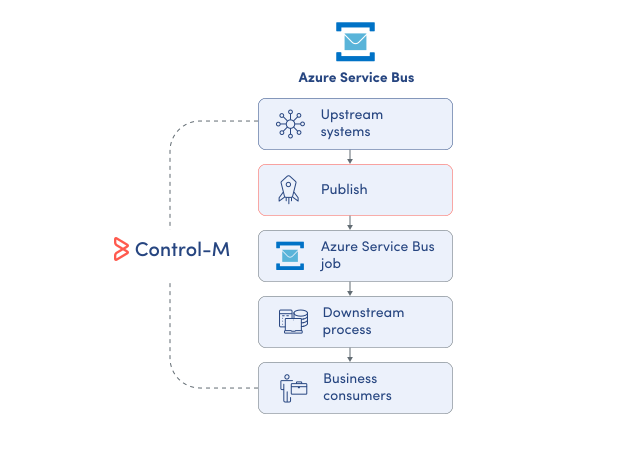
MONITOR WORKFLOWS
See Azure Service Bus jobs in workflow context.
Azure Service Bus exposes messaging behavior, but production delivery often depends on systems outside the broker. Control-M centralizes Azure Service Bus job status, results, output, dependencies, and surrounding workflow execution so platform teams can troubleshoot the complete handoff:
-
Azure Service Bus job status
-
Results and output visibility
-
Upstream and downstream dependencies
-
Cross-platform execution context
-
Workflow failure visibility
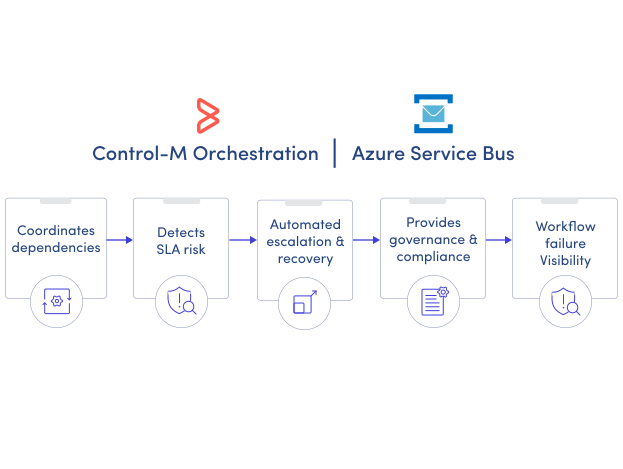
SLA ASSURANCE
Keep infrastructure provisioning aligned with production SLAs.
Azure Service Bus handles reliable messaging, but it does not own the business deadline spanning upstream and downstream systems. Control-M adds SLA management around Azure Service Bus jobs and their wider dependencies, helping teams identify and respond to delivery risk:
-
End-to-end SLA tracking
-
Messaging job SLA visibility
-
Dependency-aware workflow monitoring
-
Automated operational notifications
-
Centralized job status
Documentation
Bring order to complex workflows
Learn how Control-M helps teams orchestrate complex processes with greater visibility, coordination, and control.
