Let us know how we can help
Sales & Pricing
Speak to a rep about your business needs

Help & Support
See our product support options
General inquiries and locations
Contact us


 Control-M + Alteryx Trifacta
Your Alteryx Trifacta workflow starts before a flow ever executes — and it can fail when something upstream breaks. An Amazon S3 dataset arrives late. A Databricks transformation job misses its expected completion time. Control-M orchestrates the full chain: source data arrival, upstream transformation, Alteryx Trifacta flow execution, and downstream delivery.
common workflow issues
Does this sound like your week?
These aren’t edge cases. They’re the normal operating conditions for teams running Alteryx Trifacta flows across multiple tools. Here’s how Control‑M handles each one.
UPSTREAM DELAYS
Your S3 data is late. The Trifacta flow shouldn’t start yet.
Control-M holds the Alteryx Trifacta job until its upstream dependencies are satisfied, then releases the flow into the same scheduled workflow. Data preparation starts in sequence instead of relying on disconnected schedules or manual coordination.
FAILURE RECOVERY
Your Trifacta run timed out. A duplicate run creates another problem.
Control-M supports Trifacta idempotency tokens and controlled reruns with new tokens, helping prevent unintended duplicate execution. Teams can recover timed-out runs while preserving predictable execution and keeping downstream processing from advancing on an incomplete flow.
STATUS TRACKING
The flow started successfully. Now you need to know how it ended.
Control-M can retrack the Trifacta job using its unique Run ID and poll execution status at a configurable interval. Operators see status, results, and output from Control-M instead of manually checking another execution console.
CROSS-TOOL DEPENDENCIES
Trifacta finished. Snowflake and Databricks are still waiting downstream.
Control-M integrates Alteryx Trifacta jobs with other Control-M jobs in one scheduling environment. Completion becomes an actionable dependency, allowing downstream processing to start from actual workflow state rather than independent clocks, polling scripts, or manual handoffs.
SLA RISK
The flow is running late. Your analytics delivery window is closing.
Control-M can attach SLA management to Alteryx Trifacta jobs and track them within the broader production workflow. Teams gain earlier visibility into timing risk and can intervene before a delayed data-preparation step becomes a missed downstream delivery.
INTEGRATION FACTS
Control‑M + Alteryx Trifacta
|
workload.types |
Alteryx Trifacta flows · data preparation · data wrangling · data cleansing · transformation flows · multi-cloud data publishing |
|
trigger.type |
time schedule · upstream job completion · file arrival · API-triggered workflow · upstream Control-M condition · dependent job exit state |
|
cross_tool.deps |
Amazon S3 data arrival · Databricks job completion · Snowflake processing · AWS data services · Azure data services · Google Cloud data services · downstream Control-M jobs |
|
cloud.platforms |
AWS · Microsoft Azure · Google Cloud · Snowflake · Control-M SaaS · Control-M (self-managed) |
|
error_handling |
idempotency token · controlled rerun with new token · Run ID retracking · configurable status polling · downstream dependency control · Control-M failure handling |
|
throughput |
up to 50 simultaneous Alteryx Trifacta jobs per Control-M/Agent · scheduled batch data preparation · concurrent flow execution |
|
observability |
job status monitoring · results and output visibility · Run ID tracking · configurable status polling · SLA tracking · end-to-end dependency visibility |
end-to-end orchestration
One production workflow. Every tool in the stack.
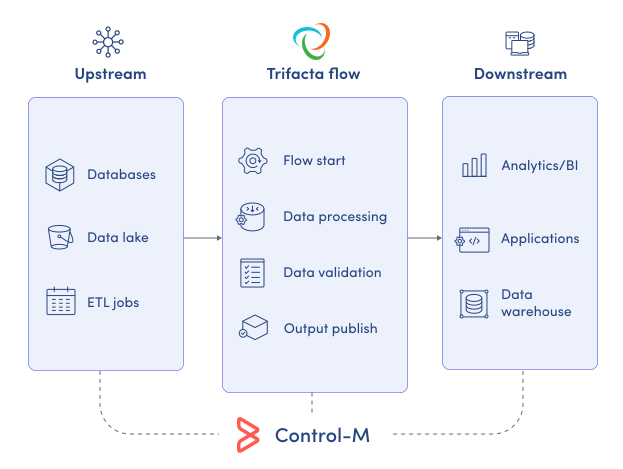
Control-M orchestrates workflows across Alteryx Trifacta, Amazon S3, Databricks, Snowflake, file transfers, and cloud services in a single job flow — with dependency tracking, SLA visibility, and automated recovery across all of them.
- Cross-tool dependency: Amazon S3 → Alteryx Trifacta → Snowflake → analytics handoff
- Data-aware triggers: file arrival, API event, upstream job completion, flow completion
|
Alteryx Trifacta |
flow execution · status tracking · results and output · SLA attachment · controlled rerun |
|
Amazon S3 |
data arrival · upstream dependency · file-driven processing |
|
Databricks |
upstream or downstream job dependency · coordinated transformation processing |
|
Snowflake |
downstream data processing · dependency-driven execution · analytics handoff |
|
File transfers |
data arrival · delivery dependencies · workflow handoffs |
|
Cloud services |
AWS · Microsoft Azure · Google Cloud workflow coordination |
MONITOR PIPELINES
Track Trifacta flow execution from one operational view.
Trifacta provides execution information for its own jobs, but production data pipelines often span several platforms. Control-M brings Trifacta status into the broader workflow view so teams can understand execution in the context of upstream and downstream dependencies:
-
Trifacta job execution status
-
Results and output visibility
-
Run ID status tracking
-
Cross-platform dependency visibility
-
Configurable status polling
SLA ASSURANCE
Keep Trifacta flows aligned with delivery SLAs.
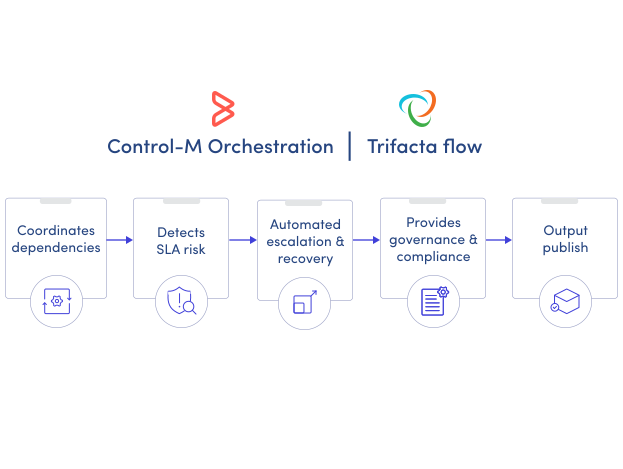
A successful Trifacta flow can still be late enough to jeopardize downstream analytics or reporting. Control-M connects the flow to end-to-end SLA management, helping teams understand its timing in the context of the complete production pipeline:
-
SLA job attachment
-
End-to-end timing visibility
-
Upstream dependency tracking
-
Downstream completion control
-
Centralized workflow monitoring
Documentation
Bring order to complex workflows
Learn how Control-M helps teams orchestrate complex processes with greater visibility, coordination, and control.
