Let us know how we can help
Sales & Pricing
Speak to a rep about your business needs

Help & Support
See our product support options
General inquiries and locations
Contact us


SAP Supply Chain Orchestration: Respond Faster When Conditions Change
Turn supply chain signals into coordinated action before delays affect inventory, production, logistics, and customer commitments.
The problem isn't detection. The problem is response.
“We knew about the issue. Why couldn’t we respond faster?”
The Three Realities of Running an SAP-Centric Supply Chain
If any of these feel familiar, you're not alone. These challenges tend to show up when supply chain performance depends less on knowing what's happening and more on how quickly you can act on it.
Visibility improves faster than response
You know about the supplier issue. You see the demand shift. The inventory risk is already on someone's dashboard. Insights arrive in real time now, but detecting a change doesn’t automatically trigger coordinated execution. Teams still have to determine what’s been affected, agree on next steps, and work across multiple systems and functions to respond.
Execution is fragmented across systems and teams
The SAP IBP forecast may be right, the production plan could be right, and the right inventory decision could be made. And yet the outcome can still be wrong. Your individual systems are working. But delays and issues show up between them, when information, dependencies, and workflows have to move across process boundaries. At some point, the hard work invested in planning unravels during execution.
Recovery takes too long
Another supplier delay. Another inventory shortage. Another logistics issue. They’re inevitable. The issue is identified quickly, but when every exception requires manual intervention and coordination, your recovery takes days, sometimes weeks. Service levels slip. Customer commitments are harder to keep. Revenue feels the impact. The disruption may be unavoidable, but the duration and business impact don’t have to be.
Why Orchestration Is a Supply Chain Priority
The common thread across all three realities is execution because knowing what to do isn't usually the problem. Coordinating what happens next is.
Orchestration helps remove that constraint by enabling you to:
- Move faster from signal to action
- Reduce dependency on manual coordination
- Respond more consistently across functions and systems
- Scale exception management without scaling headcount
- Increase resilience through faster execution
- Shorten recovery cycles and reduce service-level impacts when disruptions occur
Where Orchestration Fits in the Supply Chain
Think of orchestration as the layer that moves supply chain decisions into coordinated execution.
Orchestration turns plans, insights, and recommendations into coordinated execution across your systems, teams, and supply chain functions, helping to ensure work moves from decision to business process completion.
| Capability | In an SAP-Centric Supply Chain | Helps You Answer |
|---|---|---|
|
Planning |
SAP IBP |
What should happen? |
|
Visibility |
Demand, inventory, and supplier signals |
What's happening? |
|
AI & Analytics |
Recommendations and predictions |
What should we do next? |
|
Orchestration |
Cross-system execution |
How do we make it happen? |
How Control-M Supports SAP Supply Chain Orchestration
Control-M helps coordinate the execution activities required to turn supply chain decisions into operational outcomes.
Instead of relying on manual monitoring, disconnected scheduling tools, and team-to-team coordination, Control-M orchestrates workflows across SAP and non-SAP systems spanning planning, procurement, manufacturing, logistics, data, and partner ecosystems.
Common Supply Chain Response Scenarios
| When... | Control-M can... |
|---|---|
|
An SAP IBP planning run completes |
Trigger downstream activities, update dependent processes, and alert teams when planning deadlines are at risk. |
|
Inventory falls below threshold |
Initiate replenishment and planning workflows automatically. |
|
A supplier commitment changes |
Trigger impact-assessment workflows, update plans, notify affected teams, and coordinate downstream execution. |
How Control-M Accelerates Supply Chain Response
Cross-system dependency management
Coordinate dependencies across SAP IBP, SAP S/4HANA, warehouse systems, transportation platforms, supplier networks, and data platforms.
SAP + non-SAP workflows
Orchestrate end-to-end workflows that span SAP applications, partner ecosystems, cloud services, APIs, and other business systems.
Event-driven execution
Automatically trigger downstream processes when planning runs complete, inventory thresholds are reached, orders arrive, or business conditions change.
Workflow visibility
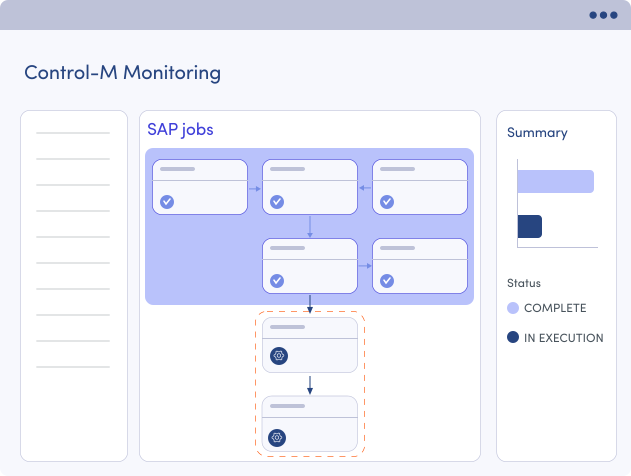
Monitor end-to-end process status and identify delays before they impact planning, production, logistics, or fulfillment.
SLA protection
Detect late-running processes, manage critical dependencies, and help keep planning cycles and service-level commitments on track.
Early issue resolution
Identify and address workflow issues before they create downstream operational disruptions.
The result is faster response when disruptions, demand shifts, or supply constraints occur.
How Orchestration Turns One Demand Signal Into Coordinated Action
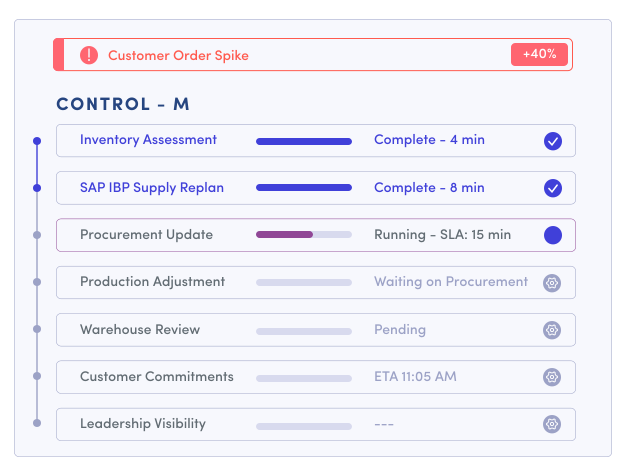
Supply chains struggle because recovery actions often have to happen across different systems, teams, and processes, under tight time pressure. Let's look at what happens when a routine supply chain event requires coordinated execution.
Monday, 8:03 AM: A major customer places an order 40% larger than forecast.
Within minutes, what starts as a single demand signal impacts inventory, planning, procurement, manufacturing, logistics, customer commitments, and leadership reporting.
Without orchestration, those activities are often managed through manual coordination, handoffs, status updates, and exception handling.
With Control-M, the response can be orchestrated through connected workflows, helping to ensure each action happens in the right order, across the right systems, at the right time.
Signs Your SAP Supply Chain Has an Execution Problem
If several of these feel familiar, your biggest supply chain constraint probably isn’t visibility or planning. It may be execution.
- Critical supply chain processes depend on manual coordination.
- Teams spend considerable time managing exceptions.
- Planning updates don't consistently trigger downstream actions.
- Operational delays are often discovered after customers are affected.
- Visibility has improved, but responsiveness hasn't.
The Supply Chain Maturity Shift Happening Now
Supply chain transformation has focused on three questions:
- Can we see what's happening?
- Can we predict what might happen?
- Can we plan for different outcomes?
Now, teams are focused on a fourth question: Can we execute a coordinated response fast enough?
As visibility, AI, planning, and analytics improve, the ability to orchestrate execution for a faster response becomes a bigger differentiator than the ability to identify issues.
What Supply Chain Teams Ask About Control-M
How does Control-M support SAP IBP planning processes?

How does Control-M coordinate SAP and non-SAP supply chain systems?
Can Control-M automate actions based on supply chain events?
How does Control-M help manage supply chain exceptions?
How does Control-M help protect planning deadlines and service-level commitments?
How does Control-M support SAP S/4HANA and SAP IBP together?
How does Control-M support SAP IBP planning processes?
How does Control-M coordinate SAP and non-SAP supply chain systems?
Can Control-M automate actions based on supply chain events?
How does Control-M help manage supply chain exceptions?
How does Control-M help protect planning deadlines and service-level commitments?
How does Control-M support SAP S/4HANA and SAP IBP together?
More SAP resources
Learn More About SAP Workflow Orchestration
Demo
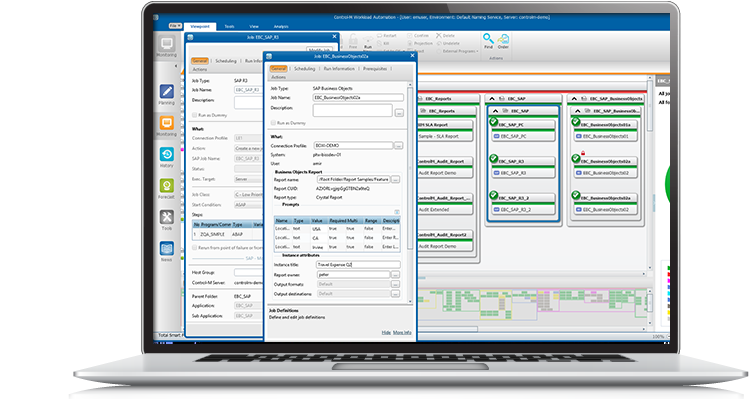
Orchestrate SAP workflows
Control-M automates and orchestrates SAP tasks, easily integrating them with non-SAP workflows.
SAP Optimization Guide
Why modern business services now depend on orchestration beyond the ERP core

Control-M for SAP®
As an SAP certified partner, Control‑M orchestrates SAP and non‑SAP workflows with end‑to‑end visibility, dependencies and recovery for S/4HANA and RISE.