Let us know how we can help
Sales & Pricing
Speak to a rep about your business needs

Help & Support
See our product support options
General inquiries and locations
Contact us


Keep Your Business Running While SAP Changes
During your RISE with SAP transformation, coordinate the systems, data, and dependencies surrounding SAP before cutover, during migration, and after go-live.
"We're not migrating an ERP. We're moving a business process that happens to depend on SAP."
Where Complexity Shows Up During RISE with SAP
You probably have a solid plan for infrastructure, data, and application modernization. Are you equally prepared to keep business processes coordinated as they begin spanning SAP S/4HANA, SAP BTP, cloud services, data platforms, file transfers, APIs, and AI-driven workflows?
That's where complexity tends to show up:
- Coordinating workloads across ECC and S/4HANA during dual-run periods
- Tracking dependencies that span SAP and non-SAP environments
- Maintaining governance as clean core initiatives move processes outside SAP
- Stabilizing operations when real-world dependencies surface after go-live
Quick take: Post-go-live surprises are often caused by dependencies nobody was watching.
What Has to Stay Aligned During RISE with SAP
Your milestones are clear. Understanding what has to stay aligned around them is where orchestration comes in.
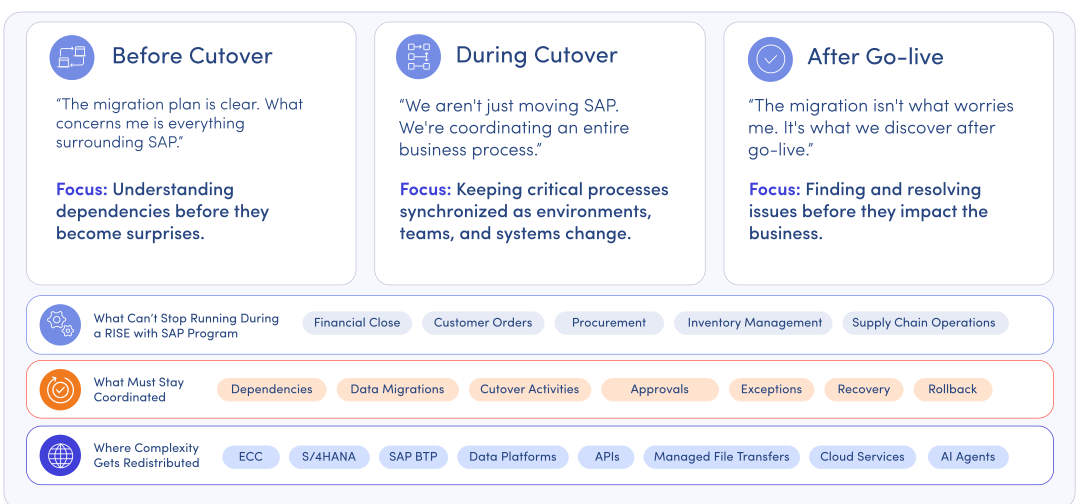
Before Transformation: Understand What Depends on SAP
Before migration planning gets too far, take a clear inventory of the processes, dependencies, and operational requirements that extend beyond SAP. What surfaces here often shapes how smoothly the rest of the program goes.
Checklist:
- Identify where clean core shifts process logic, integrations, and workflows outside SAP
- Map dependencies across SAP, SAP BTP, data platforms, file transfers, and non-SAP applications
- Determine which business processes must continue running across ECC and S/4HANA during coexistence
- Identify workflows that rely on manual handoffs, approvals, or tribal knowledge
- Validate how critical processes will operate across SAP and connected systems after cutover
- Rehearse recovery and rollback scenarios before go-live
- Define ownership, visibility, and governance requirements for post-go-live operations
During Transformation: Coordinate the Moving Parts
As cutover activities begin and environments change, pay close attention to the dependencies surrounding SAP to uncover issues you may not know existed.
Checklist:
- Coordinate cutover activities across SAP, SAP BTP, data platforms, cloud services, and file transfers
- Keep dependent workflows synchronized as systems and environments change
- Monitor readiness gates, approvals, and cutover checkpoints in real time
- Identify blocked, delayed, or failed workflows before they impact downstream activities
- Give command-center and war-room teams a shared view of execution status and dependencies
- Recover disrupted workflows without restarting entire process chains
- Execute tested contingency and rollback procedures when required
After Go-Live: Stabilize Faster
After go-live, the faster you can identify workflow issues, understand their business impact, and coordinate resolution across teams, the faster you can move beyond hypercare and into steady-state operations.
Checklist:
- Detect workflow issues before they disrupt downstream business processes
- Identify which systems, teams, and processes are affected by failures or delays
- Prioritize remediation based on business impact
- Resolve workflow issues without lengthy cross-team investigations
- Reduce the volume of manual monitoring and intervention during hypercare
- Shorten the path from go-live to steady-state operations
- Establish operational visibility and governance across SAP and connected systems
How Control-M Helps Protect Your RISE with SAP Investment
What matters after go-live isn't whether SAP ran successfully. It's whether the business process did.
Control-M helps you coordinate the dependencies, workflows, and recovery that keep those business processes running before cutover, during migration, and after go-live.
| Phase | Challenge | How Control-M helps |
|---|---|---|
| Before Cutover | Hidden workflow dependencies | Maps workflow relationships across SAP, data pipelines, managed file transfers, cloud services, and enterprise applications so you can identify dependencies before changes are introduced. |
| ECC and S/4HANA coexistence | Coordinates workflows that continue running across ECC, S/4HANA, and connected systems during migration. | |
| Unvalidated cutover assumptions | Supports dependency analysis, cutover rehearsals, workflow validation, recovery planning, and rollback preparation before go-live. | |
| During Cutover | Complex execution across systems and teams | Coordinates workflows, data migrations, handoffs, human approval points, readiness gates, and cutover activities from a single point of control. |
| Limited visibility into failures | Shows what's running, waiting, completed, failed, or blocked in real time across SAP, cloud services, data platforms, file transfers, and business applications. | |
| Slow issue recovery | Automates recovery actions and restarts workflows to help minimize business disruption. | |
| After Go-Live | Extended hypercare periods | Helps teams identify and resolve workflow issues faster across dependent systems and processes. |
| Unknown downstream impact | Helps teams understand which systems, workflows, and business processes are affected. | |
| Ongoing operational risk | Maintains coordinated execution across SAP, SAP BTP, cloud services, data platforms, and enterprise applications as operations stabilize. |
ERP modernization redistributes operational complexity. Plan for those dependencies before go-live, and you'll stabilize faster.
Quick take: RISE with SAP modernizes the ERP. Control-M helps you coordinate everything surrounding it.

Case Study: Control-M in Complex SAP Environments
Beyond SAP-Centric Scheduling
Snam, a leading European energy infrastructure company, consolidated its workload automation tools and standardized on Control-M to support a growing mix of infrastructure, applications, and business services.
Outcome: Snam improved time-to-market by 20% and reduced workflow errors by 40%.
What this shows: As dependencies extend beyond SAP, the ability to coordinate SAP and non-SAP processes becomes more important than SAP-centric scheduling alone. As Snam's IT Systems Manager explained:
"We hadn't reached that level of efficiency with Redwood, especially when managing dependencies with non-SAP processes."
Read the full story
Questions That Come Up During RISE with SAP Planning
Does RISE with SAP eliminate the need for a separate orchestration layer?

How does Clean Core affect workflow orchestration?
Does RunMyJobs work with RISE with SAP?
How should we evaluate orchestration platforms as part of a RISE with SAP strategy?
How do AI-driven workflows fit into a RISE with SAP strategy?
Why do some RISE with SAP programs require significant stabilization after go-live?
Questions That Come Up During RISE with SAP Planning
Does RISE with SAP eliminate the need for a separate orchestration layer?
How does Clean Core affect workflow orchestration?
Does RunMyJobs work with RISE with SAP?
How should we evaluate orchestration platforms as part of a RISE with SAP strategy?
How do AI-driven workflows fit into a RISE with SAP strategy?
Why do some RISE with SAP programs require significant stabilization after go-live?