Let us know how we can help
Sales & Pricing
Speak to a rep about your business needs

Help & Support
See our product support options
General inquiries and locations
Contact us


How does AI for mainframe development work?
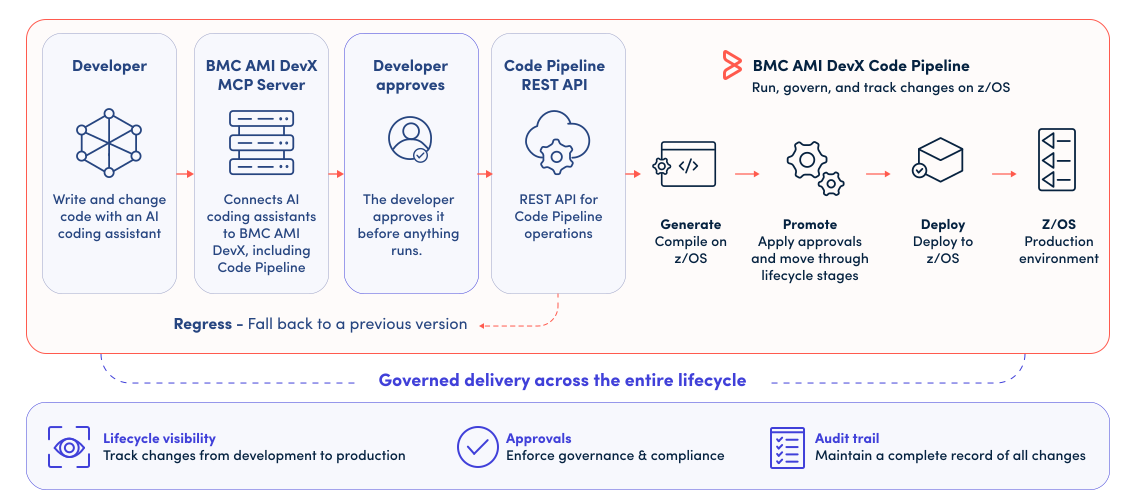
AI-assisted mainframe development places an AI coding assistant inside the delivery loop for COBOL, PL/I, JCL, and Assembler applications. The developer describes a change in their IDE session. The assistant proposes it, then invokes BMC AMI DevX Code Pipeline to compile, promote, and deploy on z/OS through the Code Pipeline MCP Server. The assistant reaches the pipeline through the same REST API that Jenkins, GitHub Actions, and Azure DevOps use, so an assistant-invoked action carries the same lifecycle visibility and the same audit record as a developer-invoked one.
Where AI coding assistants stop in mainframe development
AI accelerates coding
A distributed developer stays in one session from prompt to merge. The assistant writes the change, the pipeline picks it up, and the work moves.
The workflow breaks on z/OS
On z/OS the session breaks. The developer accepts the suggestion, leaves the assistant, and moves to a separate interface to compile, promote, and deploy. Code generation accelerates. Delivery keeps its original pace, and the gap between the two widens as assistants get better at the first half of the job.
Delivery becomes the bottleneck
In the new AI coding reality, the delivery pipeline becomes the next bottleneck. Industry observers have described this broader tension as an AI paradox in software delivery: coding accelerates, but delivery does not automatically keep pace. The same mechanism applies to mainframe delivery, only with higher stakes. The pipeline the assistant cannot reach is the one running the transactions.
How AI-assisted changes move from prompt to production on z/OS
Follow one change through BMC AMI DevX Code Pipeline, from the developer's prompt to the running program.
The developer prompts the AI coding assistant
In VS Code, Cursor, or another supported client, the developer describes the change they want. The assistant proposes it against the source it can read.
The developer approves the pipeline action
The assistant names the pipeline operation it intends to run and waits for the developer to approve it. The developer decides what ships.
Code Pipeline compiles on z/OS
BMC AMI DevX Code Pipeline runs the Generate operation. Modular compile skeletons handle COBOL, PL/I, JCL, and Assembler, and resolve copybooks against the target system.
Code Pipeline promotes through the lifecycle
Promotion moves the approved change through development, QA, and production stages, applying environment configuration and enforcing approvals at each gate.
Code Pipeline deploys and holds the fallback path
Real-time deployment status across target environments, approvals issued from web or mobile, and partial or full fallback to a valid previous version when a deployment goes wrong.
The audit trail records the work
Every action the assistant invokes writes to the same audit trail as a developer's own action, with the same lifecycle visibility behind it.
Governance for AI-driven changes through the existing pipeline
Governance is already built in
Distributed platforms built their AI governance under regulatory pressure, in public, and under deadline. Mainframe delivery has operated under audit requirements since long before AI coding assistants could propose a change, and BMC AMI DevX Code Pipeline carries that governance into every operation it runs.
The same lifecycle controls apply
An assistant-invoked Generate meets the lifecycle controls a developer-invoked Generate meets. Promotion gates apply. The audit trail captures the action. Compliance reviewers read one record covering assistant-driven and developer-driven work, in the system that already holds the evidence they ask for.
Governance extends to AI-driven delivery
This is the condition that lets AI ship into regulated delivery at all. Governance is what makes the capability deployable in financial services, insurance, and healthcare, where the alternative is a policy that keeps assistants out of the production path.
70% of organizations will embed AI agents into DevOps and DevSecOps pipelines by 2030
IDC, Katie Norton, Research Manager
What z/OS asks of an AI-assisted pipeline
The assistant behaves the same way on both platforms. The pipeline behind it does not.
| Dimension | Distributed AI-assisted delivery | What z/OS adds | What BMC AMI DevX Code Pipeline provides |
|---|---|---|---|
|
Assistant reach |
The assistant drives build and deploy through the platform API |
Build and deploy run on z/OS, outside the distributed platform's reach |
Supported assistants invoke Generate, Promote, Deploy, and Regress through the Code Pipeline REST API |
|
Build |
Compile and package portable artifacts |
Compile, link-edit, and copybook resolution against the target system |
Modular compile skeletons covering COBOL, PL/I, JCL, and Assembler |
|
Evidence |
Pipeline logs and platform audit features |
Approvals audited per change |
Lifecycle visibility and an audit trail covering assistant-invoked and developer-invoked actions alike |
|
Recovery |
Redeploy the previous artifact |
Fallback restores the running program in place |
Partial or full fallback to a valid previous version on demand |
Where BMC AMI DevX Code Pipeline sits in an AI-assisted pipeline
Code Pipeline exposes its operations through a REST API. Distributed orchestrators call it. DevOps Extensions for Jenkins, Azure DevOps, and GitHub call it. Supported AI coding assistants call it through the Code Pipeline MCP Server. One API surface, three kinds of callers, one governed execution path on z/OS. Code Pipeline is the CI/CD layer of BMC AMI DevX, BMC's mainframe developer productivity platform.
Measurable impact
217%
ROI
33%
Developers complete code changes 33% faster
50%
faster developer onboarding

Recognized for AI-augmented code modernization
BMC AMI DevX was named a Challenger in the 2026 Gartner® Magic Quadrant™ for AI-Augmented Code Modernization Tools.
AI for mainframe development FAQs
What is AI for mainframe development?

AI for mainframe development uses AI coding assistants to help developers understand, create, and modify mainframe applications. With BMC AMI DevX Code Pipeline, AI for mainframe development extends beyond code assistance by connecting supported AI coding assistants to governed build, promotion, and deployment workflows on z/OS. Developers can work with COBOL, PL/I, JCL, and Assembler while maintaining existing lifecycle controls, approvals, and audit trails.
Can AI coding assistants build and deploy mainframe code?
Which AI coding assistants work with BMC AMI DevX Code Pipeline?
How do enterprises govern AI-driven changes to mainframe applications?
Does an AI assistant need Git to work with mainframe source?
What is the Model Context Protocol (MCP), and what does it mean for mainframe CI/CD?
Can an AI assistant deploy to production without a human approving it?
What is the difference between an AI assistant that reads mainframe source and one that runs the pipeline?
How does BMC AMI DevX Code Pipeline integrate with existing mainframe DevOps tools?
AI for mainframe development FAQs
What is AI for mainframe development?
AI for mainframe development uses AI coding assistants to help developers understand, create, and modify mainframe applications. With BMC AMI DevX Code Pipeline, AI for mainframe development extends beyond code assistance by connecting supported AI coding assistants to governed build, promotion, and deployment workflows on z/OS. Developers can work with COBOL, PL/I, JCL, and Assembler while maintaining existing lifecycle controls, approvals, and audit trails.
Can AI coding assistants build and deploy mainframe code?
Which AI coding assistants work with BMC AMI DevX Code Pipeline?
How do enterprises govern AI-driven changes to mainframe applications?
Does an AI assistant need Git to work with mainframe source?
What is the Model Context Protocol (MCP), and what does it mean for mainframe CI/CD?
Can an AI assistant deploy to production without a human approving it?
What is the difference between an AI assistant that reads mainframe source and one that runs the pipeline?
How does BMC AMI DevX Code Pipeline integrate with existing mainframe DevOps tools?
